
Why This Guide Matters
Amazon Lending helps some sellers grow. But you need an invitation. If you don’t have one, don’t worry. Many other options exist. Some work better than Amazon Lending.
Amazon offers loans from $1,000 to $750,000. But only to chosen sellers. No one knows how they pick. This guide shows you other ways to get money. You’ll learn what they cost. You’ll avoid big mistakes.
What Amazon Lending Does
The Basics
Amazon Lending works by invitation only. Amazon looks at your store. They decide if you get an offer. You see offers in Seller Central.
Here’s what you get: loans from $1,000 to $750,000. You pay back over 3 to 12 months. Amazon charges a fixed fee, not interest. They take payments from your sales automatically.
Why You Didn’t Get Invited
Amazon keeps their process secret. But patterns emerge.
- Your account should be 12 months old.
- You need steady sales over $10,000 monthly.
- Your account must be in good standing.
- Your sales should grow over time.
Don’t worry if you don’t qualify now. Work on these areas. This helps your business no matter where you get money.

Other Ways to Get Money
Revenue-Based Financing
This financing type is very popular now. It works with your sales.
You get money upfront. You pay back a percent of daily sales. When sales are high, you pay more. When sales drop, you pay less. Regular loans make you pay the same amount every month. This is different.
Good companies include:
- Clearco: They offer $10,000 to $10 million. You keep full ownership. They take 6% to 15% of revenue.
- Wayflyer: They focus on online stores. They provide $10,000 to $20 million. They connect to your sales channels.
- Uncapped: They work in the UK and Europe. They offer £10,000 to £5 million. Fees run 6% to 12%.
Just be careful with these short term loans. The cost can eat into your margins, and if you don’t have healthy margins it can sink your ship.
Buyer beware.
Business Lines of Credit
This works like a credit card. But terms are usually better. You get approved for a maximum amount. You borrow what you need up to that limit.
You only pay interest on what you use. As you pay back, you can borrow again. This helps when cash runs tight. You build business credit too.
- Fundbox gives lines up to $150,000. Terms run 12 or 24 weeks. They approve you fast if you connect accounting software.
- BlueVine offers up to $250,000. Pricing is clear. Good borrowers pay prime rate plus 1.5% to 5.5%.
- American Express offers $2,000 to $250,000 if you have their business card.
Many owners make a mistake. They use all their credit at once. This costs you in interest. It can trap you in debt. Use your line for specific needs. Use it to smooth cash flow gaps.
Interest reduces your taxes per IRS Publication 535. Paying back the borrowed amount doesn’t. Keep good records of what you used money for. Personal use means no deduction.
Inventory Financing
This helps product businesses. It helps you buy stock before you make sales.
Lenders give you money to buy inventory. They use the inventory as backup. This makes the loan safer for them. You often get better terms.
- Kickfurther uses a unique model. People buy your inventory. You pay them as products sell. This costs 1% to 3% monthly.
- 8fig uses AI for funding plans. They offer $50,000 to $10 million. They help plan growth and finance inventory.
- Payability gives instant access to Amazon payouts. They offer inventory financing too.
The lender gets legal rights to your goods. Know what they can do if you can’t pay. This includes taking your inventory. Talk to a lawyer about UCC filing rules.
What is a UCC Filing?
UCC stands for Uniform Commercial Code. When you get inventory financing, the lender files a UCC-1 financing statement with your state. This is a public record that says “we have a legal claim to this business’s inventory.”
What happens if you can’t pay:
Scenario 1: You miss one payment The lender typically contacts you first. You might get a 10-30 day grace period to cure the default (fix the problem). During this time, you can catch up on payments or negotiate new terms. But the clock is ticking.
Scenario 2: You default completely The lender can legally take possession of the inventory they financed. Here’s what this looks like in practice:
- They send a notice of default
- They may show up at your warehouse or storage facility
- They can take the physical inventory
- They sell it to recover what you owe them
- If the sale doesn’t cover the full debt, you still owe the difference
Scenario 3: You try to sell the inventory without paying This gets serious. If you sell inventory that has a UCC lien on it and don’t use that money to pay the lender, this can be considered fraud. The lender can:
- Sue you personally
- File criminal charges in extreme cases
- Go after your other business assets
- Damage your business credit permanently
What creates these scenarios:
- Cash flow problems: Sales drop but you still have inventory payments
- Poor planning: Borrowing for Q4 inventory but not accounting for January/February slowdown
- Overexpansion: Taking too much inventory financing relative to your sales velocity
- Competition: Price wars force you to sell below cost, leaving nothing to pay the lender
- Account suspension: Amazon suspends your account and you can’t sell inventory to generate repayment
How to protect yourself:
- Only borrow what you can realistically repay
- Keep detailed records of which inventory is financed
- Maintain open communication with lender if problems arise
- Have a backup repayment plan (line of credit, savings buffer)
- Consider insurance for inventory loss/damage
- Read the UCC filing before signing – know exactly what collateral they’re claiming
SBA Loans
Small Business Administration loans offer great rates. But they take time. They need lots of paperwork.
SBA 7(a) loans let you borrow up to $5 million. Rates run 6% to 9%. This is prime rate plus 2.75% for loans over $50,000. You get up to 10 years for working capital. You get up to 25 years for real estate. You put down 10% to 20%.
SBA Express loans approve faster. Sometimes in 36 hours. You can borrow up to $500,000. Rates are a bit higher.
You need good qualifications. Your business should operate for 2 years. You need good credit, usually 680 or higher. You must provide a detailed business plan. Owners with 20% or more must personally guarantee. Your business must make at least 1.25 times the payment amount.
SBA loans aren’t quick. Applications take 30 to 90 days. Sometimes longer. But for large amounts or long-term needs, good terms make waiting worth it.
Interest is fully deductible. If you buy equipment, you might get bonus depreciation or Section 179 deductions.
Equipment Financing
This works for specific equipment needs. Think packaging machines. Think warehouse equipment. Think technology.
The equipment backs up the loan. This lowers your rate. You keep working capital for daily operations. You might get immediate tax deductions.
Section 179 of the tax code helps. Businesses can deduct the full equipment price in the year they buy it. The limit is $1,220,000 for 2024. Combine this with equipment financing. You get powerful cash flow benefits.
Here’s an example. You buy a $50,000 packaging system. You finance at 8% over 5 years. Your monthly payment is $1,013. But you deduct the full $50,000 from 2024 taxable income. If you pay 25% in taxes, this creates $12,500 in tax savings. This reduces what the equipment really costs.
Invoice Factoring
This works less for Amazon sellers. Amazon pays pretty fast. But if you sell to businesses or use other channels with long payment terms, this can help.
You sell unpaid invoices to a factoring company. You get 80% to 95% of their worth. You get cash right away. The company collects from your customer.
This makes sense when you have business customers with good credit. Your payment terms are 30 to 90 days. You need cash now. You accept a 2% to 5% discount.
Merchant Cash Advances
Be very careful here. These are easy to get. But costs are very high. They can trap you.
You get cash now. You give back a piece of future sales. This sounds like revenue-based financing. But important differences exist. MCAs aren’t technically loans. Providers can charge rates that would be illegal for regular loans.
Annual rates often go over 50%. Sometimes they reach 200%. Daily or weekly withdrawals can drain cash. Taking multiple MCAs creates a debt spiral. Less government oversight exists than with traditional loans.
Use these only for true emergencies. Only for very short needs of 30 to 60 days. Only when you have a solid repayment plan. Only when other options truly aren’t available.
Some states made MCA rules. But protections remain limited. New York, California, and Virginia require information disclosure. Always read the full agreement. Understand factor rate versus APR.
What is APR (Annual Percentage Rate)?
APR is the total yearly cost of borrowing expressed as a percentage. It’s standardized so you can compare loans fairly.
Example: A $10,000 loan at 10% APR for 12 months costs you $1,000 in interest over the year.
What is a Factor Rate?
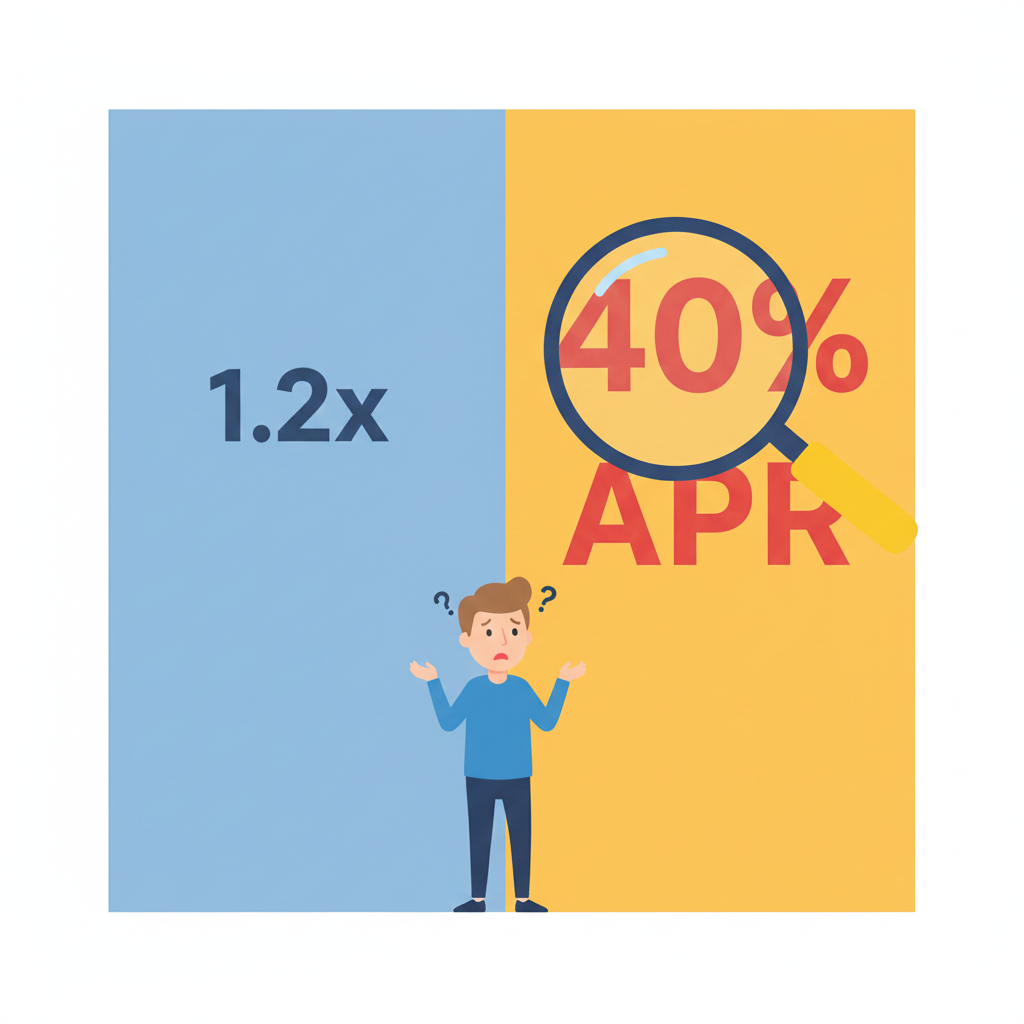
A factor rate is expressed as a decimal (like 1.2 or 1.15) that represents the total you’ll pay back. It sounds simple but hides the true cost.
Here’s the trick that confuses people:
A lender says: “We’ll give you $50,000 with a 1.2 factor rate. You just pay back $60,000. That’s only 20%!”
This sounds like 20% annual interest. But it’s NOT.
Why? Because of TIME.
If you’re repaying that $60,000 over 6 months, you’re not keeping the $50,000 for a full year. You’re paying it back quickly, which dramatically increases the real annual cost.
The Math Breakdown:
Example 1: Factor Rate Deception
- Borrow: $50,000
- Factor rate: 1.2
- Total repayment: $60,000 ($50,000 × 1.2)
- Fee: $10,000
- Repayment period: 6 months
Many think: “$10,000 on $50,000 = 20% cost”
Reality: You’re paying $10,000 to use money for only 6 months.
- If you annualized this: You’d pay $20,000 for a full year
- $20,000 on $50,000 = 40% APR
The actual APR is approximately 40%, not 20%.
Why Lenders Use Factor Rates:
Because they can legally avoid disclosing APR for business loans (unlike consumer loans which must show APR). Factor rates sound smaller and less scary than the real APR.
Revenue-Based Financing Adds Another Layer:
With revenue-based financing, you might see “10% of daily revenue until 1.2x is repaid.”
This means:
- You borrow $50,000
- You pay $57,500 total (1.15x factor)
- You pay 10% of daily revenue
If you make $5,000/day: You pay $500/day If you make $1,000/day: You pay $100/day
The faster you repay, the lower your effective APR. The slower you repay, the higher your effective APR.
Example calculation:
- Borrow $50,000 at 1.15x factor
- Total repayment: $57,500
- If you repay in 4 months: ~45% APR
- If you repay in 8 months: ~22.5% APR
- If you repay in 12 months: ~15% APR
Red Flags:
- Lender won’t tell you the APR when you ask
- They only mention factor rate or “low monthly fee”
- They say “we don’t use interest rates”
- They avoid discussing repayment timeline
- They pressure you to sign quickly
What to Do:
Always ask these questions:
- “What is the APR on this loan?”
- “What’s the total dollar amount I’ll pay back?”
- “Over what time period?”
- “Can I pay it off early without penalty?”
- “Show me an example payment schedule”
If they can’t or won’t answer clearly, walk away.
Bottom Line:
A 1.2 factor rate over 6 months is roughly 40% APR. A 10% “monthly fee” is roughly 120% APR. A “small 5% fee” for 30 days is roughly 60% APR.
Always convert factor rates to APR to understand what you’re really paying. This is how you compare apples to apples and avoid predatory lending.
Legal Rules You Need to Know
Federal Lending Laws
Truth in Lending Act requires lenders to tell you the true cost of credit. This includes APR and total repayment amount. However, TILA mainly applies to consumer lending. Many business loans fall outside its protections. Business borrowers must be even more careful.
Equal Credit Opportunity Act prohibits discrimination in lending. This covers race, color, religion, national origin, sex, marital status, age, or receipt of public assistance. If you believe you’ve been discriminated against, file a complaint with the Consumer Financial Protection Bureau.
Many states require lenders to have a license. Before working with any lender, verify they’re licensed in your state. Check with your state’s Department of Banking or Financial Services.
Tax Rules for Business Loans
When you get a business loan, the money itself isn’t taxable income. You have to pay it back. But proper documentation is essential.
Track the date you received money. Track loan agreement terms. Track purpose of the loan. Track how you spent the money. Track interest or fees you paid.
Interest paid on business loans reduces your taxes. Financing fees and origination costs do too. Bank charges related to the loan do too.
Paying back the money you borrowed doesn’t reduce taxes. Loan amounts used for non-business things don’t either. Penalties for late payments don’t. These aren’t ordinary business expenses.
If a lender forgives part of your debt, they may send Form 1099-C. This is Cancellation of Debt. This forgiven amount is usually taxable income. You may qualify for an exception under insolvency rules.
Keep a loan file with the original loan agreement. Keep the repayment schedule. Keep bank statements showing you received the money. Keep invoices and receipts for purchases made with loan funds. Keep record of all interest and fee payments. Keep an annual summary of total interest paid.

State-Specific Rules
State rules vary a lot. Some states have stronger protections.
California SB 1235 requires lenders to disclose APR, total repayment amount, and total cost for commercial loans under $500,000. Lenders must provide disclosures before you sign.
New York Commercial Financing Disclosure Law has similar requirements to California. It covers most commercial financing products. This includes revenue-based financing and merchant cash advances.
Virginia requires licensing for certain types of commercial lenders. It requires disclosure of terms.
Utah and Virginia have put in place or are considering additional MCA rules. This is because of aggressive collection practices in those states.
Check your state’s Department of Financial Institutions website for current rules.
Contract Protections
When possible, negotiate these protections into your loan agreement.
- Right to cure means you get time to fix a default before acceleration.
- Prepayment without penalty means you can pay off early and save on interest.
- Defined default events give you a clear list of what counts as default.
- Limitations on confession of judgment or eliminate it entirely.
- Choice of venue determines which state’s laws govern disputes.
- Caps on collection fees limit what the lender can charge if you default.
Personal Guarantee Impact
Many business loans require a personal guarantee. This means you’re personally responsible if the business can’t repay. This puts your personal assets at risk. This includes your home, savings, and investments.
Before signing a personal guarantee, make sure you understand the full extent of your responsibility. Consider whether you can limit the guarantee to a percentage. Understand whether the guarantee survives business bankruptcy. Know what assets are at risk. Consider the impact on your credit and future ability to borrow.
If you’re taking on significant business debt with personal guarantees, talk with an asset protection attorney. Discuss strategies like homestead exemptions. Discuss tenancy by entirety property ownership in some states. Discuss retirement account protections. Discuss proper business entity structuring.
Common Mistakes
Borrowing for Wrong Reasons
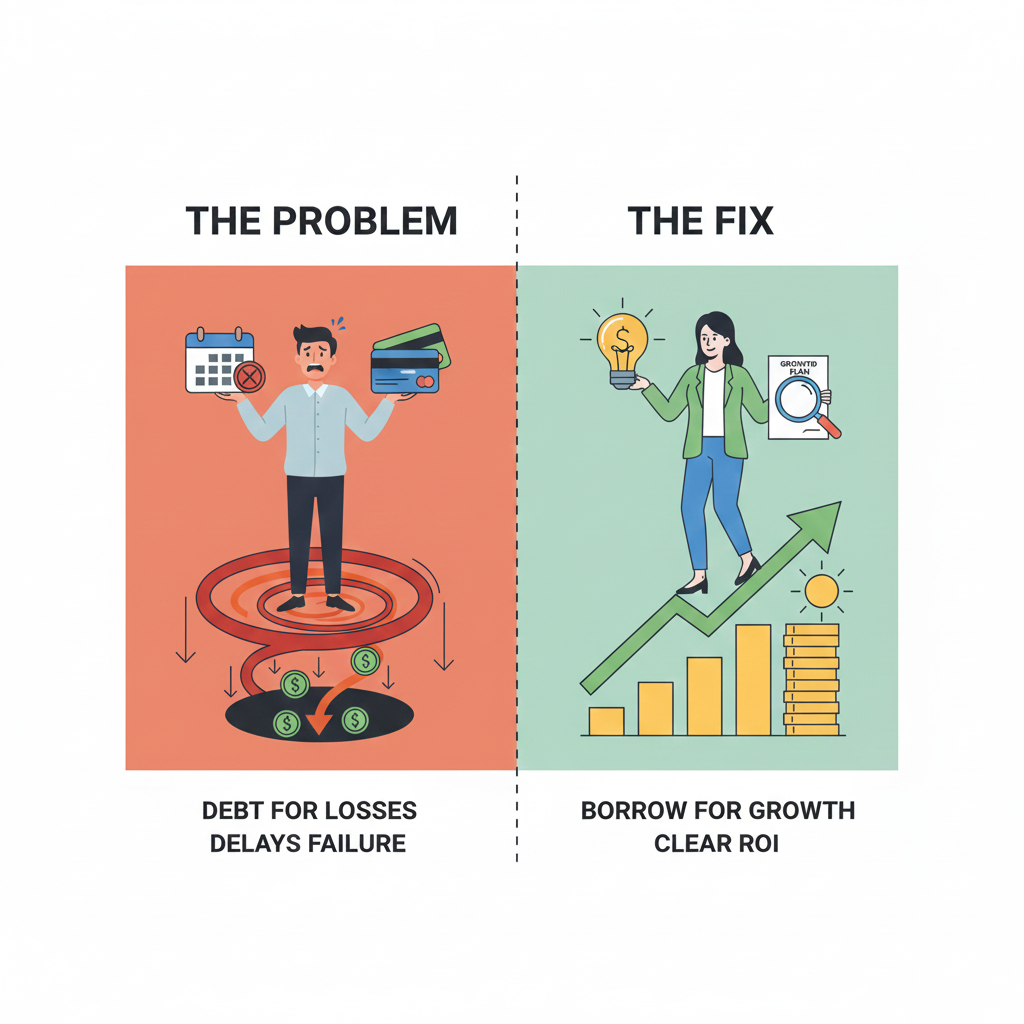
The problem is taking on debt to cover ongoing losses. This doesn’t solve your real problem. It just delays failure. It adds debt payments.
The fix is to borrow for growth opportunities with clear return projections. Don’t borrow to cover operational problems. If your business isn’t profitable before debt payments, adding debt makes things worse.
Red flags include needing a loan to cover payroll or to cover credit card payments that are coming due. Sales are down so you need money to stay open. You’re not sure where money goes but you always run short. These show operational problems. They need business fixes, not financing.
Not Understanding Real Cost
The problem is many lenders advertise attractive terms. They say factor rates of 1.2 times. They say low monthly fees of 3% to 5%. These numbers hide the true annual cost.
A 1.2 times factor rate on 6-month repayment isn’t 20% APR. It’s closer to 40% APR. You’re paying back the money over 6 months, not holding it for 12 months. A 5% monthly fee isn’t 60% APR. It’s much higher because fees compound.
Always calculate the real APR. Use this formula. APR equals total fees divided by loan amount. Multiply by 365 divided by loan term in days. Multiply by 100. Or use online APR calculators made for business loans.
Taking Too Many Loans
The problem happens when cash gets tight. Some business owners take out multiple loans at the same time. Debt payments exceed cash flow.
Warning signs include taking a new loan to make payments on an old loan. Having 3 or more active loans. More than 30% of revenue going to debt payments. Your bank balance keeps dropping even though sales stay steady.
Before taking additional financing, calculate your debt service coverage ratio. This equals your net operating income divided by total debt payments. A healthy ratio is 1.25 or higher. Below 1.0 means you don’t make enough to cover debt payments. If your ratio is falling, don’t add more debt. Work on improving operations. Work on reducing what you owe.

Ignoring Tax Planning
The problem is borrowing in December to buy inventory can create tax problems. Failing to properly document business use can prevent deductions.
You borrow $100,000 in late December to buy inventory for first quarter. You receive inventory in January. For cash-basis taxpayers, this timing creates issues. Issues exist with when you can deduct things. This may trigger unexpected taxes.
Coordinate large purchases with your tax advisor. Understand your accounting method. This is cash versus accrual. Plan accordingly. Document business purpose for all purchases made with loan money. Consider Section 179 and bonus depreciation for equipment. Time when you recognize income and expenses strategically.
The IRS watches things you use for both business and personal. This includes vehicles and home office. They watch large cash deposits without clear documentation. They watch inconsistent treatment of inventory purchases. They watch personal use of business money.
Falling for Bad Lenders
The problem is desperation makes you vulnerable. Unethical lenders use confusing terms. They use hidden fees. They use aggressive collection practices.
Warning signs include pressure to sign immediately without time to review. They won’t explain terms clearly. Fees aren’t disclosed until closing. Confession of judgment clauses appear. These are common in some MCAs. Rates seem too good to be true. Unsolicited offers come by phone or email. Lenders aren’t registered in your state.
Never sign anything without fully understanding it. Verify lender credentials and licensing. Check reviews from other businesses. Get second opinions on offers. Walk away from any deal involving pressure tactics.
Not Planning Payment Impact
The problem is when looking at loan offers, business owners focus on the first payment. They don’t think about sustaining payments over the entire term. They don’t think about continuing to operate and grow.
You take a $75,000 loan with $3,500 monthly payments. At first, your $45,000 monthly revenue covers this easily. But you haven’t planned for seasonal changes. You haven’t planned for marketing costs to maintain sales. You haven’t planned for increased advertising as competition grows. You haven’t planned for reordering inventory. You haven’t planned for unexpected expenses.
Model cash flow over the full loan term. Use conservative sales projections. Take your average monthly revenue. Reduce it by 20% for conservative planning. Subtract all operating expenses. Subtract loan payments. Make sure you still have positive cash flow with a buffer.
If your model shows negative cash flow or almost no buffer, the loan is too large. The terms are too aggressive for your business.
Final Thoughts
Getting funding is important for many online businesses. But remember that debt is a tool, not a solution. The most successful Amazon sellers view financing as fuel for proven growth strategies. They don’t view it as a lifeline for struggling businesses.
Perfect your unit economics first.
Know your exact cost per unit.
Know your selling price.
Know Amazon fees.
Know advertising cost.
Know profit margin.
If these basics aren’t strong, more money won’t fix the problem.
Test before scaling. Use small amounts of money to prove your strategy works. Then borrow larger sums.
Maintain multiple funding relationships. Don’t rely on just one source of money. Having relationships with 2 to 3 lenders gives you options when opportunities come up.
Build business credit separately from personal credit. Over time, separate your business and personal finances completely. This protects you personally. This improves your business’s ability to borrow.
Plan for seasons and market changes. Online selling is cyclical. Your financing strategy should account for holiday spikes. It should account for post-holiday slowdowns. It should account for competitive pressures.
Reinvest profits strategically. The best financing is self-financing. As your business grows, keep earnings. This reduces how much you depend on outside money.
You may not have access to Amazon Lending. But the alternative financing world offers strong options.
Often these come with better terms.
Often these come with more flexibility.
Often these come with faster access to money.
Approach financing strategically. Understand the true costs. Follow legal rules. Focus on sustainable growth. You can build a thriving online business regardless of Amazon’s invitation-only program.
The most important factor isn’t which lender you choose. It isn’t what rate you pay. It’s what you do with the money once you have it.
Use these funds to create value. Improve your operations. Build a business that generates enough cash. This reduces your future need for outside financing.
If you need help with any of this, like getting your financials straight so you can approach lenders to get money, lets talk.
We can help you with strategy.
We can help you with knowing your numbers to the penny so you know whether it’s a good move or not to go get some money.
Take Control of Your Finances Today!
Whether you’re a Reseller (Wholesale, Retail Arbitrage, Online Arbitrage, Dropshipping) or a Brand Owner, managing finances is key to your success. We support eCommerce businesses across major platforms like Amazon, Shopify, eBay, Walmart, Etsy, BigCommerce, and beyond.
See if you qualify for a free strategy session with our team to learn how Tall Oak Advisors can streamline your bookkeeping and ensure accurate tax preparation for your business.
Need a quick quote?
Or explore our range of free resources crafted specifically for eCommerce sellers:
- Business Tax Worksheet
- Frequently Asked Questions About Taxes and Bookkeeping
- Tax Write-Offs Every Amazon and Shopify Seller Should Know
Take the first step toward a stronger financial future and position your business for long-term success.
Why This Guide Matters
Amazon Lending helps some sellers grow. But you need an invitation. If you don’t have one, don’t worry. Many other options exist. Some work better than Amazon Lending.
Amazon offers loans from $1,000 to $750,000. But only to chosen sellers. No one knows how they pick. This guide shows you other ways to get money. You’ll learn what they cost. You’ll avoid big mistakes.
What Amazon Lending Does
The Basics
Amazon Lending works by invitation only. Amazon looks at your store. They decide if you get an offer. You see offers in Seller Central.
Here’s what you get: loans from $1,000 to $750,000. You pay back over 3 to 12 months. Amazon charges a fixed fee, not interest. They take payments from your sales automatically.
Why You Didn’t Get Invited
Amazon keeps their process secret. But patterns emerge.
- Your account should be 12 months old.
- You need steady sales over $10,000 monthly.
- Your account must be in good standing.
- Your sales should grow over time.
Don’t worry if you don’t qualify now. Work on these areas. This helps your business no matter where you get money.
Other Ways to Get Money
Revenue-Based Financing
This financing type is very popular now. It works with your sales.
You get money upfront. You pay back a percent of daily sales. When sales are high, you pay more. When sales drop, you pay less. Regular loans make you pay the same amount every month. This is different.
Good companies include:
- Clearco: They offer $10,000 to $10 million. You keep full ownership. They take 6% to 15% of revenue.
- Wayflyer: They focus on online stores. They provide $10,000 to $20 million. They connect to your sales channels.
- Uncapped: They work in the UK and Europe. They offer £10,000 to £5 million. Fees run 6% to 12%.
Just be careful with these short term loans. The cost can eat into your margins, and if you don’t have healthy margins it can sink your ship.
Buyer beware.
Business Lines of Credit
This works like a credit card. But terms are usually better. You get approved for a maximum amount. You borrow what you need up to that limit.
You only pay interest on what you use. As you pay back, you can borrow again. This helps when cash runs tight. You build business credit too.
- Fundbox gives lines up to $150,000. Terms run 12 or 24 weeks. They approve you fast if you connect accounting software.
- BlueVine offers up to $250,000. Pricing is clear. Good borrowers pay prime rate plus 1.5% to 5.5%.
- American Express offers $2,000 to $250,000 if you have their business card.
Many owners make a mistake. They use all their credit at once. This costs you in interest. It can trap you in debt. Use your line for specific needs. Use it to smooth cash flow gaps.
Interest reduces your taxes per IRS Publication 535. Paying back the borrowed amount doesn’t. Keep good records of what you used money for. Personal use means no deduction.
Inventory Financing
This helps product businesses. It helps you buy stock before you make sales.
Lenders give you money to buy inventory. They use the inventory as backup. This makes the loan safer for them. You often get better terms.
- Kickfurther uses a unique model. People buy your inventory. You pay them as products sell. This costs 1% to 3% monthly.
- 8fig uses AI for funding plans. They offer $50,000 to $10 million. They help plan growth and finance inventory.
- Payability gives instant access to Amazon payouts. They offer inventory financing too.
The lender gets legal rights to your goods. Know what they can do if you can’t pay. This includes taking your inventory. Talk to a lawyer about UCC filing rules.
What is a UCC Filing?
UCC stands for Uniform Commercial Code. When you get inventory financing, the lender files a UCC-1 financing statement with your state. This is a public record that says “we have a legal claim to this business’s inventory.”
What happens if you can’t pay:
Scenario 1: You miss one payment The lender typically contacts you first. You might get a 10-30 day grace period to cure the default (fix the problem). During this time, you can catch up on payments or negotiate new terms. But the clock is ticking.
Scenario 2: You default completely The lender can legally take possession of the inventory they financed. Here’s what this looks like in practice:
- They send a notice of default
- They may show up at your warehouse or storage facility
- They can take the physical inventory
- They sell it to recover what you owe them
- If the sale doesn’t cover the full debt, you still owe the difference
Scenario 3: You try to sell the inventory without paying This gets serious. If you sell inventory that has a UCC lien on it and don’t use that money to pay the lender, this can be considered fraud. The lender can:
- Sue you personally
- File criminal charges in extreme cases
- Go after your other business assets
- Damage your business credit permanently
What creates these scenarios:
- Cash flow problems: Sales drop but you still have inventory payments
- Poor planning: Borrowing for Q4 inventory but not accounting for January/February slowdown
- Overexpansion: Taking too much inventory financing relative to your sales velocity
- Competition: Price wars force you to sell below cost, leaving nothing to pay the lender
- Account suspension: Amazon suspends your account and you can’t sell inventory to generate repayment
How to protect yourself:
- Only borrow what you can realistically repay
- Keep detailed records of which inventory is financed
- Maintain open communication with lender if problems arise
- Have a backup repayment plan (line of credit, savings buffer)
- Consider insurance for inventory loss/damage
- Read the UCC filing before signing – know exactly what collateral they’re claiming
SBA Loans
Small Business Administration loans offer great rates. But they take time. They need lots of paperwork.
SBA 7(a) loans let you borrow up to $5 million. Rates run 6% to 9%. This is prime rate plus 2.75% for loans over $50,000. You get up to 10 years for working capital. You get up to 25 years for real estate. You put down 10% to 20%.
SBA Express loans approve faster. Sometimes in 36 hours. You can borrow up to $500,000. Rates are a bit higher.
You need good qualifications. Your business should operate for 2 years. You need good credit, usually 680 or higher. You must provide a detailed business plan. Owners with 20% or more must personally guarantee. Your business must make at least 1.25 times the payment amount.
SBA loans aren’t quick. Applications take 30 to 90 days. Sometimes longer. But for large amounts or long-term needs, good terms make waiting worth it.
Interest is fully deductible. If you buy equipment, you might get bonus depreciation or Section 179 deductions.
Equipment Financing
This works for specific equipment needs. Think packaging machines. Think warehouse equipment. Think technology.
The equipment backs up the loan. This lowers your rate. You keep working capital for daily operations. You might get immediate tax deductions.
Section 179 of the tax code helps. Businesses can deduct the full equipment price in the year they buy it. The limit is $1,220,000 for 2024. Combine this with equipment financing. You get powerful cash flow benefits.
Here’s an example. You buy a $50,000 packaging system. You finance at 8% over 5 years. Your monthly payment is $1,013. But you deduct the full $50,000 from 2024 taxable income. If you pay 25% in taxes, this creates $12,500 in tax savings. This reduces what the equipment really costs.
Invoice Factoring
This works less for Amazon sellers. Amazon pays pretty fast. But if you sell to businesses or use other channels with long payment terms, this can help.
You sell unpaid invoices to a factoring company. You get 80% to 95% of their worth. You get cash right away. The company collects from your customer.
This makes sense when you have business customers with good credit. Your payment terms are 30 to 90 days. You need cash now. You accept a 2% to 5% discount.
Merchant Cash Advances
Be very careful here. These are easy to get. But costs are very high. They can trap you.
You get cash now. You give back a piece of future sales. This sounds like revenue-based financing. But important differences exist. MCAs aren’t technically loans. Providers can charge rates that would be illegal for regular loans.
Annual rates often go over 50%. Sometimes they reach 200%. Daily or weekly withdrawals can drain cash. Taking multiple MCAs creates a debt spiral. Less government oversight exists than with traditional loans.
Use these only for true emergencies. Only for very short needs of 30 to 60 days. Only when you have a solid repayment plan. Only when other options truly aren’t available.
Some states made MCA rules. But protections remain limited. New York, California, and Virginia require information disclosure. Always read the full agreement. Understand factor rate versus APR.
What is APR (Annual Percentage Rate)?
APR is the total yearly cost of borrowing expressed as a percentage. It’s standardized so you can compare loans fairly.
Example: A $10,000 loan at 10% APR for 12 months costs you $1,000 in interest over the year.
What is a Factor Rate?
A factor rate is expressed as a decimal (like 1.2 or 1.15) that represents the total you’ll pay back. It sounds simple but hides the true cost.
Here’s the trick that confuses people:
A lender says: “We’ll give you $50,000 with a 1.2 factor rate. You just pay back $60,000. That’s only 20%!”
This sounds like 20% annual interest. But it’s NOT.
Why? Because of TIME.
If you’re repaying that $60,000 over 6 months, you’re not keeping the $50,000 for a full year. You’re paying it back quickly, which dramatically increases the real annual cost.
The Math Breakdown:
Example 1: Factor Rate Deception
- Borrow: $50,000
- Factor rate: 1.2
- Total repayment: $60,000 ($50,000 × 1.2)
- Fee: $10,000
- Repayment period: 6 months
Many think: “$10,000 on $50,000 = 20% cost”
Reality: You’re paying $10,000 to use money for only 6 months.
- If you annualized this: You’d pay $20,000 for a full year
- $20,000 on $50,000 = 40% APR
The actual APR is approximately 40%, not 20%.
Why Lenders Use Factor Rates:
Because they can legally avoid disclosing APR for business loans (unlike consumer loans which must show APR). Factor rates sound smaller and less scary than the real APR.
Revenue-Based Financing Adds Another Layer:
With revenue-based financing, you might see “10% of daily revenue until 1.2x is repaid.”
This means:
- You borrow $50,000
- You pay $57,500 total (1.15x factor)
- You pay 10% of daily revenue
If you make $5,000/day: You pay $500/day If you make $1,000/day: You pay $100/day
The faster you repay, the lower your effective APR. The slower you repay, the higher your effective APR.
Example calculation:
- Borrow $50,000 at 1.15x factor
- Total repayment: $57,500
- If you repay in 4 months: ~45% APR
- If you repay in 8 months: ~22.5% APR
- If you repay in 12 months: ~15% APR
Red Flags:
- Lender won’t tell you the APR when you ask
- They only mention factor rate or “low monthly fee”
- They say “we don’t use interest rates”
- They avoid discussing repayment timeline
- They pressure you to sign quickly
What to Do:
Always ask these questions:
- “What is the APR on this loan?”
- “What’s the total dollar amount I’ll pay back?”
- “Over what time period?”
- “Can I pay it off early without penalty?”
- “Show me an example payment schedule”
If they can’t or won’t answer clearly, walk away.
Bottom Line:
A 1.2 factor rate over 6 months is roughly 40% APR. A 10% “monthly fee” is roughly 120% APR. A “small 5% fee” for 30 days is roughly 60% APR.
Always convert factor rates to APR to understand what you’re really paying. This is how you compare apples to apples and avoid predatory lending.
Legal Rules You Need to Know
Federal Lending Laws
Truth in Lending Act requires lenders to tell you the true cost of credit. This includes APR and total repayment amount. However, TILA mainly applies to consumer lending. Many business loans fall outside its protections. Business borrowers must be even more careful.
Equal Credit Opportunity Act prohibits discrimination in lending. This covers race, color, religion, national origin, sex, marital status, age, or receipt of public assistance. If you believe you’ve been discriminated against, file a complaint with the Consumer Financial Protection Bureau.
Many states require lenders to have a license. Before working with any lender, verify they’re licensed in your state. Check with your state’s Department of Banking or Financial Services.
Tax Rules for Business Loans
When you get a business loan, the money itself isn’t taxable income. You have to pay it back. But proper documentation is essential.
Track the date you received money. Track loan agreement terms. Track purpose of the loan. Track how you spent the money. Track interest or fees you paid.
Interest paid on business loans reduces your taxes. Financing fees and origination costs do too. Bank charges related to the loan do too.
Paying back the money you borrowed doesn’t reduce taxes. Loan amounts used for non-business things don’t either. Penalties for late payments don’t. These aren’t ordinary business expenses.
If a lender forgives part of your debt, they may send Form 1099-C. This is Cancellation of Debt. This forgiven amount is usually taxable income. You may qualify for an exception under insolvency rules.
Keep a loan file with the original loan agreement. Keep the repayment schedule. Keep bank statements showing you received the money. Keep invoices and receipts for purchases made with loan funds. Keep record of all interest and fee payments. Keep an annual summary of total interest paid.
State-Specific Rules
State rules vary a lot. Some states have stronger protections.
California SB 1235 requires lenders to disclose APR, total repayment amount, and total cost for commercial loans under $500,000. Lenders must provide disclosures before you sign.
New York Commercial Financing Disclosure Law has similar requirements to California. It covers most commercial financing products. This includes revenue-based financing and merchant cash advances.
Virginia requires licensing for certain types of commercial lenders. It requires disclosure of terms.
Utah and Virginia have put in place or are considering additional MCA rules. This is because of aggressive collection practices in those states.
Check your state’s Department of Financial Institutions website for current rules.
Contract Protections
When possible, negotiate these protections into your loan agreement.
- Right to cure means you get time to fix a default before acceleration.
- Prepayment without penalty means you can pay off early and save on interest.
- Defined default events give you a clear list of what counts as default.
- Limitations on confession of judgment or eliminate it entirely.
- Choice of venue determines which state’s laws govern disputes.
- Caps on collection fees limit what the lender can charge if you default.
Personal Guarantee Impact
Many business loans require a personal guarantee. This means you’re personally responsible if the business can’t repay. This puts your personal assets at risk. This includes your home, savings, and investments.
Before signing a personal guarantee, make sure you understand the full extent of your responsibility. Consider whether you can limit the guarantee to a percentage. Understand whether the guarantee survives business bankruptcy. Know what assets are at risk. Consider the impact on your credit and future ability to borrow.
If you’re taking on significant business debt with personal guarantees, talk with an asset protection attorney. Discuss strategies like homestead exemptions. Discuss tenancy by entirety property ownership in some states. Discuss retirement account protections. Discuss proper business entity structuring.
Common Mistakes
Borrowing for Wrong Reasons
The problem is taking on debt to cover ongoing losses. This doesn’t solve your real problem. It just delays failure. It adds debt payments.
The fix is to borrow for growth opportunities with clear return projections. Don’t borrow to cover operational problems. If your business isn’t profitable before debt payments, adding debt makes things worse.
Red flags include needing a loan to cover payroll or to cover credit card payments that are coming due. Sales are down so you need money to stay open. You’re not sure where money goes but you always run short. These show operational problems. They need business fixes, not financing.
Not Understanding Real Cost
The problem is many lenders advertise attractive terms. They say factor rates of 1.2 times. They say low monthly fees of 3% to 5%. These numbers hide the true annual cost.
A 1.2 times factor rate on 6-month repayment isn’t 20% APR. It’s closer to 40% APR. You’re paying back the money over 6 months, not holding it for 12 months. A 5% monthly fee isn’t 60% APR. It’s much higher because fees compound.
Always calculate the real APR. Use this formula. APR equals total fees divided by loan amount. Multiply by 365 divided by loan term in days. Multiply by 100. Or use online APR calculators made for business loans.
Taking Too Many Loans
The problem happens when cash gets tight. Some business owners take out multiple loans at the same time. Debt payments exceed cash flow.
Warning signs include taking a new loan to make payments on an old loan. Having 3 or more active loans. More than 30% of revenue going to debt payments. Your bank balance keeps dropping even though sales stay steady.
Before taking additional financing, calculate your debt service coverage ratio. This equals your net operating income divided by total debt payments. A healthy ratio is 1.25 or higher. Below 1.0 means you don’t make enough to cover debt payments. If your ratio is falling, don’t add more debt. Work on improving operations. Work on reducing what you owe.
Ignoring Tax Planning
The problem is borrowing in December to buy inventory can create tax problems. Failing to properly document business use can prevent deductions.
You borrow $100,000 in late December to buy inventory for first quarter. You receive inventory in January. For cash-basis taxpayers, this timing creates issues. Issues exist with when you can deduct things. This may trigger unexpected taxes.
Coordinate large purchases with your tax advisor. Understand your accounting method. This is cash versus accrual. Plan accordingly. Document business purpose for all purchases made with loan money. Consider Section 179 and bonus depreciation for equipment. Time when you recognize income and expenses strategically.
The IRS watches things you use for both business and personal. This includes vehicles and home office. They watch large cash deposits without clear documentation. They watch inconsistent treatment of inventory purchases. They watch personal use of business money.
Falling for Bad Lenders
The problem is desperation makes you vulnerable. Unethical lenders use confusing terms. They use hidden fees. They use aggressive collection practices.
Warning signs include pressure to sign immediately without time to review. They won’t explain terms clearly. Fees aren’t disclosed until closing. Confession of judgment clauses appear. These are common in some MCAs. Rates seem too good to be true. Unsolicited offers come by phone or email. Lenders aren’t registered in your state.
Never sign anything without fully understanding it. Verify lender credentials and licensing. Check reviews from other businesses. Get second opinions on offers. Walk away from any deal involving pressure tactics.
Not Planning Payment Impact
The problem is when looking at loan offers, business owners focus on the first payment. They don’t think about sustaining payments over the entire term. They don’t think about continuing to operate and grow.
You take a $75,000 loan with $3,500 monthly payments. At first, your $45,000 monthly revenue covers this easily. But you haven’t planned for seasonal changes. You haven’t planned for marketing costs to maintain sales. You haven’t planned for increased advertising as competition grows. You haven’t planned for reordering inventory. You haven’t planned for unexpected expenses.
Model cash flow over the full loan term. Use conservative sales projections. Take your average monthly revenue. Reduce it by 20% for conservative planning. Subtract all operating expenses. Subtract loan payments. Make sure you still have positive cash flow with a buffer.
If your model shows negative cash flow or almost no buffer, the loan is too large. The terms are too aggressive for your business.
Final Thoughts
Getting funding is important for many online businesses. But remember that debt is a tool, not a solution. The most successful Amazon sellers view financing as fuel for proven growth strategies. They don’t view it as a lifeline for struggling businesses.
Perfect your unit economics first.
Know your exact cost per unit.
Know your selling price.
Know Amazon fees.
Know advertising cost.
Know profit margin.
If these basics aren’t strong, more money won’t fix the problem.
Test before scaling. Use small amounts of money to prove your strategy works. Then borrow larger sums.
Maintain multiple funding relationships. Don’t rely on just one source of money. Having relationships with 2 to 3 lenders gives you options when opportunities come up.
Build business credit separately from personal credit. Over time, separate your business and personal finances completely. This protects you personally. This improves your business’s ability to borrow.
Plan for seasons and market changes. Online selling is cyclical. Your financing strategy should account for holiday spikes. It should account for post-holiday slowdowns. It should account for competitive pressures.
Reinvest profits strategically. The best financing is self-financing. As your business grows, keep earnings. This reduces how much you depend on outside money.
You may not have access to Amazon Lending. But the alternative financing world offers strong options.
Often these come with better terms.
Often these come with more flexibility.
Often these come with faster access to money.
Approach financing strategically. Understand the true costs. Follow legal rules. Focus on sustainable growth. You can build a thriving online business regardless of Amazon’s invitation-only program.
The most important factor isn’t which lender you choose. It isn’t what rate you pay. It’s what you do with the money once you have it.
Use these funds to create value. Improve your operations. Build a business that generates enough cash. This reduces your future need for outside financing.
If you need help with any of this, like getting your financials straight so you can approach lenders to get money, lets talk.
We can help you with strategy.
We can help you with knowing your numbers to the penny so you know whether it’s a good move or not to go get some money.
Take Control of Your Finances Today!
Whether you’re a Reseller (Wholesale, Retail Arbitrage, Online Arbitrage, Dropshipping) or a Brand Owner, managing finances is key to your success. We support eCommerce businesses across major platforms like Amazon, Shopify, eBay, Walmart, Etsy, BigCommerce, and beyond.
See if you qualify for a free strategy session with our team to learn how Tall Oak Advisors can streamline your bookkeeping and ensure accurate tax preparation for your business.
Need a quick quote?
Or explore our range of free resources crafted specifically for eCommerce sellers:
- 7 Profit Crushing Mistakes That Will Destroy Your eCommerce Business
- Business Tax Worksheet
- Frequently Asked Questions About Taxes and Bookkeeping
- Tax Write-Offs Every Amazon and Shopify Seller Should Know
Take the first step toward a stronger financial future and position your business for long-term success.