

Short answer: Yes. Amazon does handle sales tax collection and remittance as a marketplace facilitator, but sellers still have reporting and registration responsibilities.
Let’s break that down.
What Amazon Does
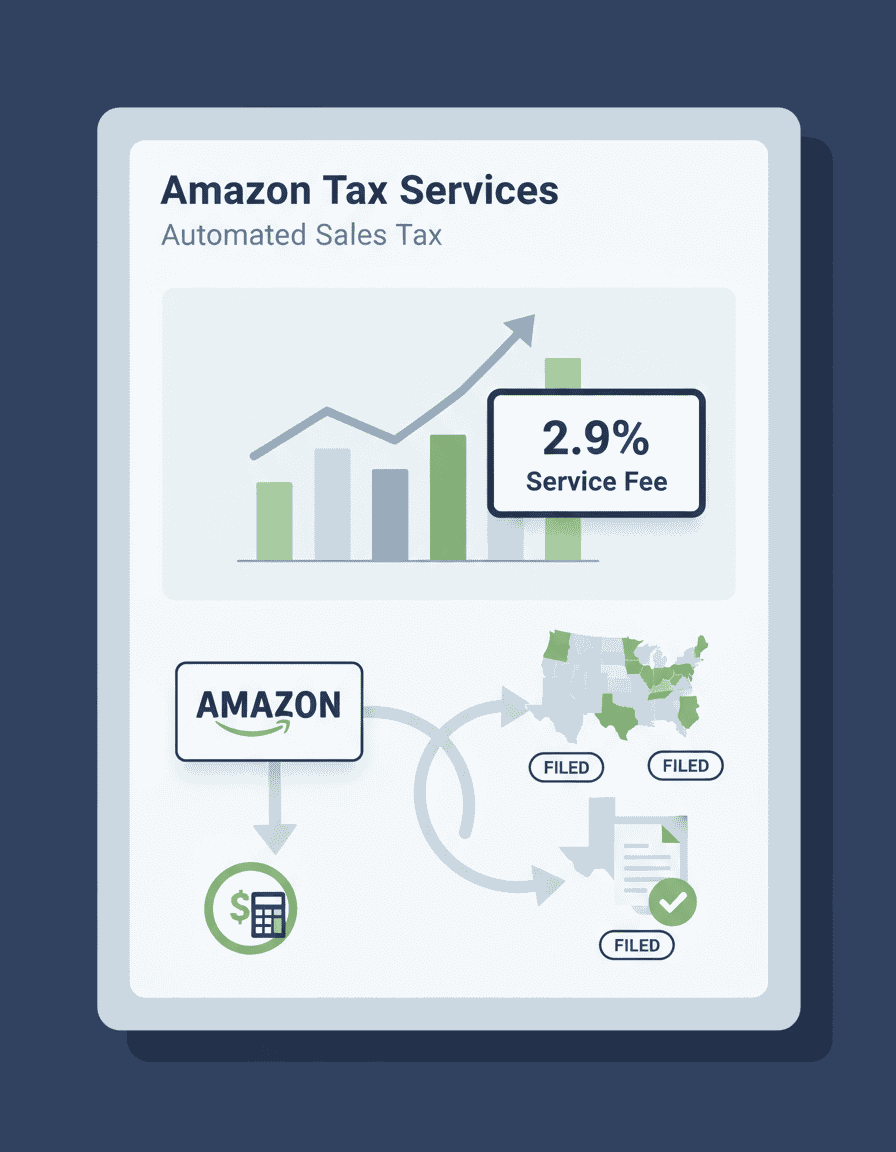
Amazon is required by law to calculate, collect, and remit sales tax on behalf of third-party sellers in all states with Marketplace Facilitator laws.
That means:
-
Amazon automatically handles the sales tax burden for orders placed through its platform.
-
Sellers don’t need to manually calculate or send payments for those transactions.
-
Amazon typically charges a 2.9% processing fee per transaction for this service.
Each month, Amazon files a combined return in every state where it’s required. Including its own sales and third-party sellers’ sales.
Your sales are reported under Amazon’s marketplace return, simplifying the process compared to pre-2018 practices when sellers had to file and remit tax directly.
What Sellers Still Must Do
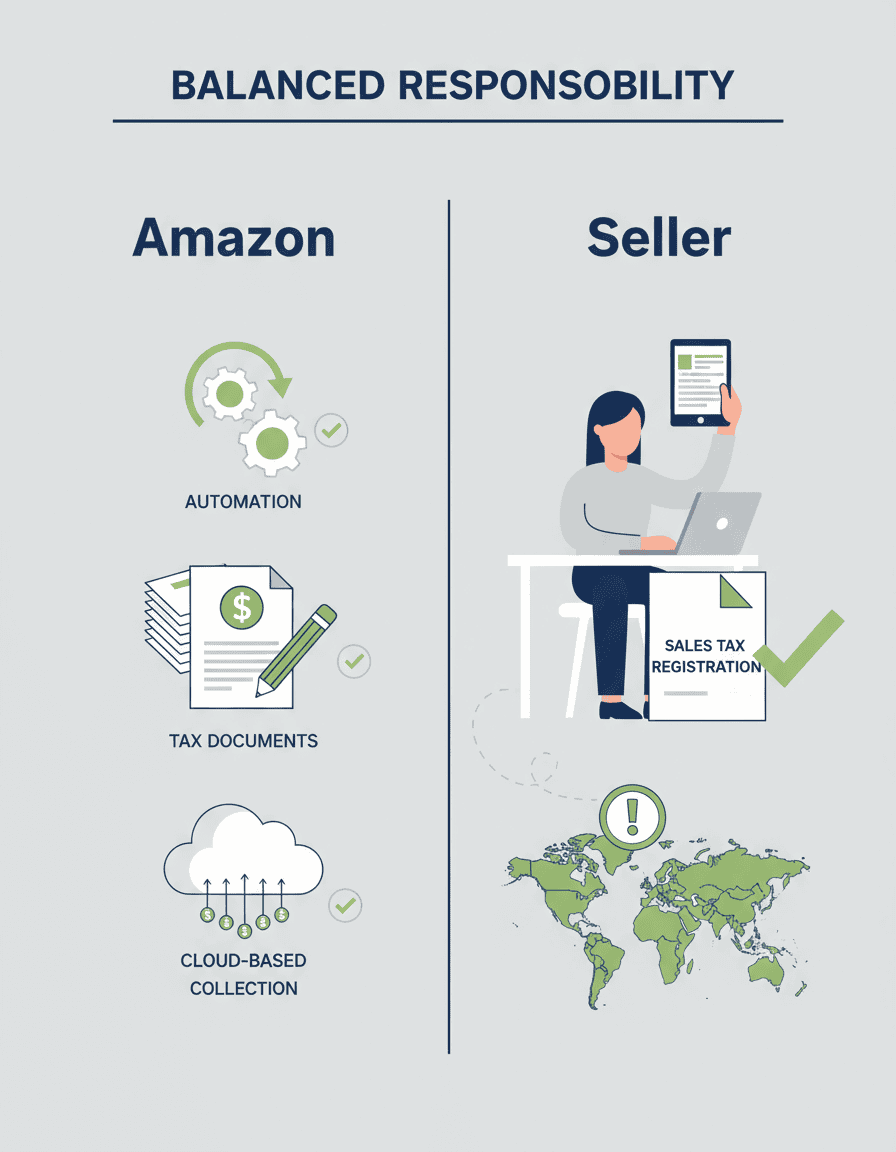
Even though Amazon takes care of collection and remittance, sellers still have reporting responsibilities.
1. File in Your Home State
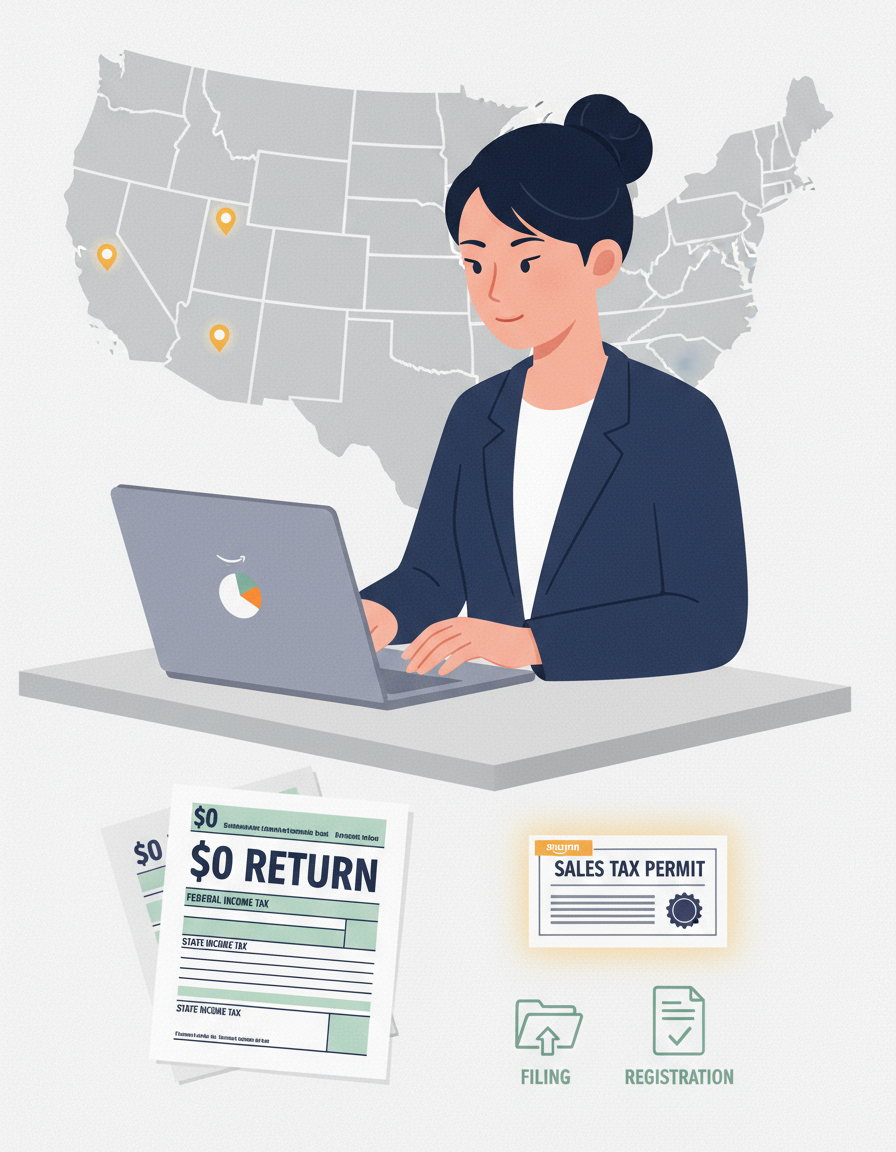
Even when Amazon collects and remits the tax, many states still require you to file a sales tax return.
If Amazon already remitted on your behalf, you’ll typically file what’s called a $0 return — reporting zero taxable sales since Amazon handled the tax.
2. Register Where You Have Nexus
If your business has sales tax nexus (a physical or economic presence) in any state, you’re still responsible for registering for a sales tax permit in that state — even if all your sales are through Amazon.
Additional Considerations
Physical Nexus from FBA Inventory
If you use Fulfillment by Amazon (FBA), your inventory may be stored in multiple states.
That physical presence automatically creates nexus, meaning you may need to register for sales tax in each of those states.
Multi-Channel Selling
Amazon only collects and remits sales tax for sales made on its platform.
If you sell through your own website, eBay, Shopify, or other marketplaces, you must handle sales tax collection and remittance for those channels yourself.
State Variations
Not every state has sales tax. States like Montana, New Hampshire, and certain parts of Alaska don’t require collection at all.
Key Takeaways
While Amazon handles the heavy lifting like calculating, collecting, and remitting sales tax. You’re still responsible for proper registration and filing.
In short:
Amazon simplifies sales tax, but it doesn’t remove your obligations.
Failing to register or file can lead to compliance issues later. Especially if you expand beyond Amazon or use FBA warehouses in multiple states.
Frequently Asked Amazon Sales Tax Questions
For eCom businesses selling on marketplaces such as Amazon, eBay, and Walmart, the marketplaces collect and remit sales taxes on your behalf. However, most states still require you to file a sales tax return with them regularly. This is otherwise known as filing a $0 Due Sales Tax Return. Fill out the normal sales tax remittance form with the same information as you normally would, as if you collected sales tax. It’s best to follow the state’s instructions for the form.
The main difference between a $0 due sales tax return and a regular sales tax return is that you want the final amount due to show $0. On the form, there is space for “exempt revenue” or a similar field, depending on the state. That exempt revenue number should match the taxable revenue number on the form. By doing so, it tells the state that all your taxable revenue is exempt, which means the balance due is $0.
Note: Some states explicitly state you should not put any marketplace sales on the form itself. If that is the case, you would enter $0 for both taxable and exempt revenue.
Several automation platforms have emerged to simplify sales tax management for e-commerce sellers. Services like Avalara, TaxJar, and Taxify integrate with Amazon and other sales channels to automatically calculate, collect, and remit sales tax across multiple jurisdictions. These platforms track your nexus obligations, monitor threshold changes, and generate filing-ready reports.
For Amazon-specific needs, Seller Central’s native Tax Settings provide basic functionality for configuring collection by state. While not as comprehensive as dedicated platforms, these built-in tools handle fundamental requirements for many sellers. More sophisticated operations benefit from third-party integrations that sync transaction data across all sales channels for consolidated reporting.
Accounting software like QuickBooks and Xero also offer sales tax features, though they typically require more manual configuration than specialized compliance platforms. When choosing tools, consider your sales volume, number of states where you operate, and whether you need automated filing services. Many platforms offer tiered pricing based on transaction volume, making professional-grade compliance accessible even to smaller sellers just starting their expansion.
Hiring a sales tax expert depends on your business complexity and risk tolerance. If you’re selling significant volumes across multiple states, dealing with past compliance gaps, or facing an audit, professional guidance becomes invaluable. Tax professionals understand the nuances of nexus laws, exemption certificate management, and state-specific filing requirements that can save you from costly mistakes.
For smaller operations with straightforward sales patterns, you might manage compliance using software tools and self-education. However, as your business grows or enters new states, the complexity increases exponentially. A qualified professional can handle registrations, calculate obligations accurately, prepare returns, and represent you during audits.
Consider the cost-benefit analysis carefully. Professional fees often pale in comparison to penalties for non-compliance, back taxes with interest, or the time you’d spend learning complex regulations. Many sellers find that hiring help during critical periods like establishing initial compliance or resolving historical issues provides tremendous value while allowing them to focus on growing their business.
One frequent error is assuming Amazon handles all sales tax automatically. While they collect tax in many states, sellers remain responsible for understanding their own obligations, especially for merchant-fulfilled orders or states with special rules. Failing to register in states where you have nexus creates significant compliance risks and potential back-tax liability.
Another common mistake is misapplying Product Tax Codes. Using the wrong PTC can result in incorrect tax collection, leaving you either over-collecting (and owing refunds) or under-collecting (and paying the difference yourself). Neglecting to configure tax settings properly in Seller Central compounds these issues, particularly when expanding to new marketplaces or states.
Many sellers also fail to maintain adequate records or miss filing deadlines even when no tax is due. Some states require zero-dollar returns to maintain compliance. Additionally, not participating in ATEP when you have business customers means missing opportunities for tax-exempt sales. Finally, ignoring voluntary disclosure programs when you discover past non-compliance often results in harsher penalties than proactive resolution would have incurred.
Sales tax documentation in Seller Central lives in several key locations. Navigate to Reports, then Tax Document Library to find your annual 1099-K forms and other tax-related documents Amazon generates. This section stores historical forms making it easy to retrieve information from previous years when needed.
For transaction-level detail, go to Reports and select Payments to access your Date Range Reports. These comprehensive files contain order-by-order information including taxes collected. You can filter by date range and download the data in various formats. The All Orders report under Orders also provides sales details with tax information.
Your Tax Settings area is another important location. Access it through Settings, then Tax Settings to view your nexus configurations, exemption certificates uploaded through ATEP, and Product Tax Code defaults. Regularly reviewing these sections ensures your documentation stays current and accessible for filing requirements or potential audits.
Record retention requirements vary by state, but most jurisdictions require you to maintain sales tax documentation for a minimum of three to four years. Some states mandate retention periods as long as six or seven years from the filing date. The safest approach is to keep records for at least four years to cover the majority of state requirements.
Your retention obligation begins from the date you file your return or the due date, whichever is later. If you never filed a required return, the statute of limitations may never expire in some states, meaning you should retain those records indefinitely. In audit situations, having comprehensive records readily available demonstrates good faith compliance.
Consider keeping digital copies stored securely in cloud systems for easy retrieval. Important documents to preserve include sales invoices, exemption certificates, state returns filed, and marketplace facilitator reports from Amazon. Establishing an organized filing system from the start prevents scrambling during potential audits.
Amazon offers several reporting tools to help sellers monitor and manage their sales tax obligations. The Transaction View report in Seller Central displays individual order details including tax collected by jurisdiction. You can access summary reports showing tax collection totals by state for specified time periods.
The Date Range Reports section provides downloadable data files containing comprehensive transaction information. These reports include fields for marketplace facilitator tax collection, allowing you to reconcile amounts Amazon collected on your behalf. Many third-party accounting tools can import these files directly.
For sellers using FBA, the FBA Customer Returns Report and Settlement Reports also contain tax-related information. These reports help you track refunds and adjustments that affect your net tax liability. Regularly reviewing these reports ensures accurate record-keeping for compliance purposes.
Yes. You’re typically disqualified if a state has already contacted you about sales tax issues – even if you’ve received a nexus questionnaire. If you’re already registered for sales tax in that state, or if you’ve been collecting tax there, you may also be ineligible.
This makes proactive action critical. Act before states reach out to you to maximize your eligibility for the most favorable terms. Once a state initiates contact, you lose negotiating power and access to VDA benefits like penalty waivers and shortened look-back periods.
The Multistate Tax Commission’s Online Marketplace Seller Voluntary Disclosure Initiative that operated in 2017 has ended. However, individual states continue offering their own VDA programs year-round for businesses needing to achieve compliance.
While the national amnesty program is no longer available, you can still work with a sales tax professional to explore current VDA options in specific states where you have exposure. Contact a professional to identify which states offer programs that could minimize your penalties and back tax liability.
A Voluntary Disclosure Agreement (VDA) is a contractual arrangement between your business and a state tax authority where you voluntarily reveal past tax liabilities in exchange for concessions. These typically include reduced look-back periods (usually 3-4 years instead of the full statutory period) and waived penalties.
Most states permit anonymous applications through a tax professional. This approach allows you to come into compliance proactively before states contact you, potentially saving significant money on penalties and interest while limiting your exposure to back taxes.
If you discover you should have been collecting sales tax but weren’t, you may face back tax liability plus penalties and interest. States have the authority to audit sellers and demand payment of uncollected sales tax directly from your pocket, which can be financially devastating for small businesses.
The consequences can be severe, but addressing the issue proactively is crucial. Contact a sales tax professional immediately to assess your exposure and explore options like Voluntary Disclosure Agreements that can reduce penalties and provide manageable payment plans.
Access your Tax Document Library through Seller Central to view exempt orders. The reporting section shows which orders qualified for tax exemptions, with data displayed in the Buyer Exemption column.
Exemption certificates are accessible in your Sales Tax Report under the Tax-Exemption Certificates tab, typically appearing within 72 hours of the order. This allows you to verify legitimate exemptions and maintain proper documentation for your records and potential audits.
When filing your federal income tax return, you’ll need to report the gross receipts amount from your 1099-K, then deduct the sales tax you collected as either an expense or an adjustment on Schedule C.
This is essential because sales tax isn’t income – it’s money collected on behalf of state governments that you’re required to remit. By deducting it, you ensure you’re only paying income tax on your actual business earnings, not on funds that simply passed through your accounts to reach state tax authorities. You never truly received this money as income, so it shouldn’t be taxed as such.
Yes, if you operate as an individual seller or single-member LLC, you’re responsible for paying self-employment tax. This tax covers your Social Security and Medicare contributions at a current rate of 15.3% calculated on your net earnings.
Self-employment tax is separate from both sales tax and income tax. While you collect sales tax from customers for states, and pay income tax on profits for the IRS, self-employment tax is your contribution to the social security system as a business owner. It’s calculated after you’ve deducted all business expenses, including the sales tax you collected and remitted.
When you sell on multiple channels beyond Amazon – such as your own Shopify store, eBay, Walmart, or other platforms – you become fully responsible for tracking where you have sales tax nexus, calculating appropriate tax rates across 11,000+ jurisdictions, collecting sales tax at checkout, and remitting payments to each state on schedule.
You’ll need to monitor your nexus status across all channels combined and implement tax calculation software or manual processes for compliance on non-Amazon sales. Consider using automated sales tax solutions like Avalara or TaxJar to handle this complexity efficiently.
When running your own e-commerce website, you’re entirely responsible for every aspect of sales tax compliance. This includes determining where you have nexus, calculating accurate sales tax rates across over 11,000 jurisdictions, collecting the correct tax at checkout, filing returns in each applicable state, and making timely payments.
This is significantly more complex than selling on Amazon. Most sellers use automated solutions like Avalara or TaxJar to integrate with their e-commerce platform, automatically calculating rates and managing compliance. Attempting to handle this manually is extremely difficult and error-prone given the complexity of multi-state tax rules.
Yes. When you use Amazon’s Multi-Channel Fulfillment service to ship orders from other sales channels (like your Shopify store or eBay), you remain fully responsible for collecting and remitting sales tax on those non-Amazon orders.
Amazon only manages tax collection for sales made directly through the Amazon marketplace. For MCF orders, you’re responsible as if you were shipping them yourself – you must collect the appropriate sales tax at checkout and remit it to states. Amazon simply acts as your fulfillment center for these orders, not as the marketplace facilitator.
ATEP is an optional program designed for Amazon Business sellers that enables tax-exempt organizations – including government entities, schools, nonprofits, and resellers – to make purchases without paying sales tax.
When you participate in ATEP, Amazon automatically manages the collection of exemption certificates and stores them in your Tax Document Library. This streamlines the process of selling to tax-exempt buyers, as Amazon handles the administrative burden of certificate management for you.
No, ATEP participation is completely optional. You’re not required to join the program to sell on Amazon.
However, participating can provide significant benefits. It reduces buyer inquiries about tax settings, minimizes the risk of post-purchase tax refund requests, and potentially increases your sales to business and institutional buyers who prefer tax-exempt purchasing. The program handles certificate management automatically, making it a convenient option if you want to serve tax-exempt customers without the administrative hassle.
Yes, the 1099-K includes all sales tax that was collected from your customers. The gross sales figure shown on your 1099-K represents the total amount received, including the sales tax portions.
This is a crucial detail because when calculating your actual taxable income on Schedule C, you must subtract the sales tax amount. Since sales tax is money you collected on behalf of states and never actually earned as income, you need to deduct it as an expense or adjustment. Failing to do so means you’ll be paying income tax on money that was simply passed through your business to state tax authorities.
Form 1099-K is an IRS tax form that Amazon issues to report your total gross sales for the year. For the 2024 tax year, you’ll receive a 1099-K if your sales exceeded $5,000. This threshold will decrease to $2,500 in 2025 and $600 in 2026, as thresholds continue to be lowered.
The form reports your gross sales to the IRS, helping ensure accurate income reporting. It’s important to note that this is a reporting document – you still need to calculate your actual taxable income by deducting your business expenses from these gross sales figures.
Yes, sales tax and income tax are completely separate types of taxes with different purposes and recipients.
Sales tax is collected from your customers at the point of sale and must be remitted to state governments. You’re acting as a collection agent for the state – this money never belongs to you.
Income tax, on the other hand, is paid on your business profits to the federal government (IRS) and potentially to state governments as well. This is calculated based on your net earnings after expenses.
Both types of taxes must be filed and reported separately, and they’re calculated using entirely different methods. It’s critical not to confuse the two, as they serve distinct purposes in your tax obligations.
Absolutely. Using the wrong Product Tax Codes can lead to serious complications for your Amazon business. When you apply incorrect PTCs, you risk collecting the wrong sales tax amount from customers, which can result in:
• Compliance issues with state tax authorities
• Customer complaints and refund requests
• Potential audit problems from states
• Financial liability if you under-collect taxes
The consequences can be financially devastating for small sellers, as states may demand payment of uncollected taxes directly from your pocket, often with added penalties and interest. Always ensure you select the PTC that accurately represents your product category to avoid these risks.
Product Tax Codes (PTCs) are classifications created by Amazon to help apply the correct sales tax rate to your products in each state. Tax rates vary by category. For instance, clothing, groceries, and books may each be taxed differently, or even exempt altogether in certain jurisdictions.
To set up sales tax collection, log in to Amazon Seller Central and navigate to Settings → Tax Settings. From there, add your sales tax registration numbers for each state where you have a tax obligation, and assign the correct Product Tax Codes (PTCs) to your listings. Once configured, Amazon automatically calculates and collects the right tax based on each buyer’s location.
While all sales tax states have marketplace facilitator laws, the thresholds that trigger the collection requirement vary:
$100,000 threshold states: Most states including Arkansas, Colorado, Georgia, Idaho, Indiana, Iowa, Kansas, Nevada, New Mexico, Ohio, Oklahoma, Pennsylvania, South Carolina, South Dakota, Utah, Vermont, Virginia, and Wisconsin
$250,000 threshold states: Alabama (for Simplified Sellers Use Tax), Connecticut, and Mississippi
$500,000 threshold states: California (for remote sellers) and Tennessee
No threshold/Universal collection: California, New Jersey, Texas, and West Virginia require marketplace facilitators to collect sales tax on all sales regardless of volume
Key Effective Dates
The rollout of these laws occurred over several years:
-
2018: Minnesota (October 1), New Jersey (November 1), Connecticut (December 1)
-
2019: Iowa, Pennsylvania, Oklahoma, and many others throughout the year
-
2020: Louisiana, Mississippi, Tennessee
-
2021: Florida (July 1), Kansas (July 1)
-
2023: Missouri (January 1) – the final state to adopt such a law
The comprehensive adoption of marketplace facilitator laws means that platforms like Amazon, eBay, Etsy, and Walmart now automatically collect and remit sales tax on behalf of third-party sellers in every state where sales tax applies.
All 45 states with sales tax (plus Washington D.C.) now have marketplace facilitator laws in effect. Missouri was the last state to enact its marketplace facilitator law on January 1, 2023, meaning complete nationwide coverage now exists.
States Without Sales Tax
Only five states have no sales tax and therefore no marketplace facilitator laws:
-
Montana
-
New Hampshire
-
Oregon
-
Delaware
-
Alaska (no statewide sales tax, though some local jurisdictions have their own marketplace facilitator requirements)
Take Control of Your Finances Today!
Whether you’re a Reseller (Wholesale, Retail Arbitrage, Online Arbitrage, Dropshipping) or a Brand Owner, managing finances is key to your success. We support eCommerce businesses across major platforms like Amazon, Shopify, eBay, Walmart, Etsy, BigCommerce, and beyond.
See if you qualify for a free strategy session with our team to learn how Tall Oak Advisors can streamline your bookkeeping and ensure accurate tax preparation for your business.
Need a quick quote?
Or explore our range of free resources crafted specifically for eCommerce sellers:
- Business Tax Worksheet
- Frequently Asked Questions About Taxes and Bookkeeping
- Tax Write-Offs Every Amazon and Shopify Seller Should Know
Take the first step toward a stronger financial future and position your business for long-term success.
Short answer: Yes. Amazon does handle sales tax collection and remittance as a marketplace facilitator, but sellers still have reporting and registration responsibilities.
Let’s break that down.
What Amazon Does
Amazon is required by law to calculate, collect, and remit sales tax on behalf of third-party sellers in all states with Marketplace Facilitator laws.
That means:
-
Amazon automatically handles the sales tax burden for orders placed through its platform.
-
Sellers don’t need to manually calculate or send payments for those transactions.
-
Amazon typically charges a 2.9% processing fee per transaction for this service.
Each month, Amazon files a combined return in every state where it’s required. Including its own sales and third-party sellers’ sales.
Your sales are reported under Amazon’s marketplace return, simplifying the process compared to pre-2018 practices when sellers had to file and remit tax directly.
What Sellers Still Must Do
Even though Amazon takes care of collection and remittance, sellers still have reporting responsibilities.
1. File in Your Home State
Even when Amazon collects and remits the tax, many states still require you to file a sales tax return.
If Amazon already remitted on your behalf, you’ll typically file what’s called a $0 return — reporting zero taxable sales since Amazon handled the tax.
2. Register Where You Have Nexus
If your business has sales tax nexus (a physical or economic presence) in any state, you’re still responsible for registering for a sales tax permit in that state — even if all your sales are through Amazon.
Additional Considerations
Physical Nexus from FBA Inventory
If you use Fulfillment by Amazon (FBA), your inventory may be stored in multiple states.
That physical presence automatically creates nexus, meaning you may need to register for sales tax in each of those states.
Multi-Channel Selling
Amazon only collects and remits sales tax for sales made on its platform.
If you sell through your own website, eBay, Shopify, or other marketplaces, you must handle sales tax collection and remittance for those channels yourself.
State Variations
Not every state has sales tax. States like Montana, New Hampshire, and certain parts of Alaska don’t require collection at all.
Key Takeaways
While Amazon handles the heavy lifting like calculating, collecting, and remitting sales tax. You’re still responsible for proper registration and filing.
In short:
Amazon simplifies sales tax, but it doesn’t remove your obligations.
Failing to register or file can lead to compliance issues later. Especially if you expand beyond Amazon or use FBA warehouses in multiple states.
Frequently Asked Amazon Sales Tax Questions
For eCom businesses selling on marketplaces such as Amazon, eBay, and Walmart, the marketplaces collect and remit sales taxes on your behalf. However, most states still require you to file a sales tax return with them regularly. This is otherwise known as filing a $0 Due Sales Tax Return. Fill out the normal sales tax remittance form with the same information as you normally would, as if you collected sales tax. It’s best to follow the state’s instructions for the form.
The main difference between a $0 due sales tax return and a regular sales tax return is that you want the final amount due to show $0. On the form, there is space for “exempt revenue” or a similar field, depending on the state. That exempt revenue number should match the taxable revenue number on the form. By doing so, it tells the state that all your taxable revenue is exempt, which means the balance due is $0.
Note: Some states explicitly state you should not put any marketplace sales on the form itself. If that is the case, you would enter $0 for both taxable and exempt revenue.
Several automation platforms have emerged to simplify sales tax management for e-commerce sellers. Services like Avalara, TaxJar, and Taxify integrate with Amazon and other sales channels to automatically calculate, collect, and remit sales tax across multiple jurisdictions. These platforms track your nexus obligations, monitor threshold changes, and generate filing-ready reports.
For Amazon-specific needs, Seller Central’s native Tax Settings provide basic functionality for configuring collection by state. While not as comprehensive as dedicated platforms, these built-in tools handle fundamental requirements for many sellers. More sophisticated operations benefit from third-party integrations that sync transaction data across all sales channels for consolidated reporting.
Accounting software like QuickBooks and Xero also offer sales tax features, though they typically require more manual configuration than specialized compliance platforms. When choosing tools, consider your sales volume, number of states where you operate, and whether you need automated filing services. Many platforms offer tiered pricing based on transaction volume, making professional-grade compliance accessible even to smaller sellers just starting their expansion.
Hiring a sales tax expert depends on your business complexity and risk tolerance. If you’re selling significant volumes across multiple states, dealing with past compliance gaps, or facing an audit, professional guidance becomes invaluable. Tax professionals understand the nuances of nexus laws, exemption certificate management, and state-specific filing requirements that can save you from costly mistakes.
For smaller operations with straightforward sales patterns, you might manage compliance using software tools and self-education. However, as your business grows or enters new states, the complexity increases exponentially. A qualified professional can handle registrations, calculate obligations accurately, prepare returns, and represent you during audits.
Consider the cost-benefit analysis carefully. Professional fees often pale in comparison to penalties for non-compliance, back taxes with interest, or the time you’d spend learning complex regulations. Many sellers find that hiring help during critical periods like establishing initial compliance or resolving historical issues provides tremendous value while allowing them to focus on growing their business.
One frequent error is assuming Amazon handles all sales tax automatically. While they collect tax in many states, sellers remain responsible for understanding their own obligations, especially for merchant-fulfilled orders or states with special rules. Failing to register in states where you have nexus creates significant compliance risks and potential back-tax liability.
Another common mistake is misapplying Product Tax Codes. Using the wrong PTC can result in incorrect tax collection, leaving you either over-collecting (and owing refunds) or under-collecting (and paying the difference yourself). Neglecting to configure tax settings properly in Seller Central compounds these issues, particularly when expanding to new marketplaces or states.
Many sellers also fail to maintain adequate records or miss filing deadlines even when no tax is due. Some states require zero-dollar returns to maintain compliance. Additionally, not participating in ATEP when you have business customers means missing opportunities for tax-exempt sales. Finally, ignoring voluntary disclosure programs when you discover past non-compliance often results in harsher penalties than proactive resolution would have incurred.
Sales tax documentation in Seller Central lives in several key locations. Navigate to Reports, then Tax Document Library to find your annual 1099-K forms and other tax-related documents Amazon generates. This section stores historical forms making it easy to retrieve information from previous years when needed.
For transaction-level detail, go to Reports and select Payments to access your Date Range Reports. These comprehensive files contain order-by-order information including taxes collected. You can filter by date range and download the data in various formats. The All Orders report under Orders also provides sales details with tax information.
Your Tax Settings area is another important location. Access it through Settings, then Tax Settings to view your nexus configurations, exemption certificates uploaded through ATEP, and Product Tax Code defaults. Regularly reviewing these sections ensures your documentation stays current and accessible for filing requirements or potential audits.
Record retention requirements vary by state, but most jurisdictions require you to maintain sales tax documentation for a minimum of three to four years. Some states mandate retention periods as long as six or seven years from the filing date. The safest approach is to keep records for at least four years to cover the majority of state requirements.
Your retention obligation begins from the date you file your return or the due date, whichever is later. If you never filed a required return, the statute of limitations may never expire in some states, meaning you should retain those records indefinitely. In audit situations, having comprehensive records readily available demonstrates good faith compliance.
Consider keeping digital copies stored securely in cloud systems for easy retrieval. Important documents to preserve include sales invoices, exemption certificates, state returns filed, and marketplace facilitator reports from Amazon. Establishing an organized filing system from the start prevents scrambling during potential audits.
Amazon offers several reporting tools to help sellers monitor and manage their sales tax obligations. The Transaction View report in Seller Central displays individual order details including tax collected by jurisdiction. You can access summary reports showing tax collection totals by state for specified time periods.
The Date Range Reports section provides downloadable data files containing comprehensive transaction information. These reports include fields for marketplace facilitator tax collection, allowing you to reconcile amounts Amazon collected on your behalf. Many third-party accounting tools can import these files directly.
For sellers using FBA, the FBA Customer Returns Report and Settlement Reports also contain tax-related information. These reports help you track refunds and adjustments that affect your net tax liability. Regularly reviewing these reports ensures accurate record-keeping for compliance purposes.
Yes. You’re typically disqualified if a state has already contacted you about sales tax issues – even if you’ve received a nexus questionnaire. If you’re already registered for sales tax in that state, or if you’ve been collecting tax there, you may also be ineligible.
This makes proactive action critical. Act before states reach out to you to maximize your eligibility for the most favorable terms. Once a state initiates contact, you lose negotiating power and access to VDA benefits like penalty waivers and shortened look-back periods.
The Multistate Tax Commission’s Online Marketplace Seller Voluntary Disclosure Initiative that operated in 2017 has ended. However, individual states continue offering their own VDA programs year-round for businesses needing to achieve compliance.
While the national amnesty program is no longer available, you can still work with a sales tax professional to explore current VDA options in specific states where you have exposure. Contact a professional to identify which states offer programs that could minimize your penalties and back tax liability.
A Voluntary Disclosure Agreement (VDA) is a contractual arrangement between your business and a state tax authority where you voluntarily reveal past tax liabilities in exchange for concessions. These typically include reduced look-back periods (usually 3-4 years instead of the full statutory period) and waived penalties.
Most states permit anonymous applications through a tax professional. This approach allows you to come into compliance proactively before states contact you, potentially saving significant money on penalties and interest while limiting your exposure to back taxes.
If you discover you should have been collecting sales tax but weren’t, you may face back tax liability plus penalties and interest. States have the authority to audit sellers and demand payment of uncollected sales tax directly from your pocket, which can be financially devastating for small businesses.
The consequences can be severe, but addressing the issue proactively is crucial. Contact a sales tax professional immediately to assess your exposure and explore options like Voluntary Disclosure Agreements that can reduce penalties and provide manageable payment plans.
Access your Tax Document Library through Seller Central to view exempt orders. The reporting section shows which orders qualified for tax exemptions, with data displayed in the Buyer Exemption column.
Exemption certificates are accessible in your Sales Tax Report under the Tax-Exemption Certificates tab, typically appearing within 72 hours of the order. This allows you to verify legitimate exemptions and maintain proper documentation for your records and potential audits.
When filing your federal income tax return, you’ll need to report the gross receipts amount from your 1099-K, then deduct the sales tax you collected as either an expense or an adjustment on Schedule C.
This is essential because sales tax isn’t income – it’s money collected on behalf of state governments that you’re required to remit. By deducting it, you ensure you’re only paying income tax on your actual business earnings, not on funds that simply passed through your accounts to reach state tax authorities. You never truly received this money as income, so it shouldn’t be taxed as such.
Yes, if you operate as an individual seller or single-member LLC, you’re responsible for paying self-employment tax. This tax covers your Social Security and Medicare contributions at a current rate of 15.3% calculated on your net earnings.
Self-employment tax is separate from both sales tax and income tax. While you collect sales tax from customers for states, and pay income tax on profits for the IRS, self-employment tax is your contribution to the social security system as a business owner. It’s calculated after you’ve deducted all business expenses, including the sales tax you collected and remitted.
When you sell on multiple channels beyond Amazon – such as your own Shopify store, eBay, Walmart, or other platforms – you become fully responsible for tracking where you have sales tax nexus, calculating appropriate tax rates across 11,000+ jurisdictions, collecting sales tax at checkout, and remitting payments to each state on schedule.
You’ll need to monitor your nexus status across all channels combined and implement tax calculation software or manual processes for compliance on non-Amazon sales. Consider using automated sales tax solutions like Avalara or TaxJar to handle this complexity efficiently.
When running your own e-commerce website, you’re entirely responsible for every aspect of sales tax compliance. This includes determining where you have nexus, calculating accurate sales tax rates across over 11,000 jurisdictions, collecting the correct tax at checkout, filing returns in each applicable state, and making timely payments.
This is significantly more complex than selling on Amazon. Most sellers use automated solutions like Avalara or TaxJar to integrate with their e-commerce platform, automatically calculating rates and managing compliance. Attempting to handle this manually is extremely difficult and error-prone given the complexity of multi-state tax rules.
Yes. When you use Amazon’s Multi-Channel Fulfillment service to ship orders from other sales channels (like your Shopify store or eBay), you remain fully responsible for collecting and remitting sales tax on those non-Amazon orders.
Amazon only manages tax collection for sales made directly through the Amazon marketplace. For MCF orders, you’re responsible as if you were shipping them yourself – you must collect the appropriate sales tax at checkout and remit it to states. Amazon simply acts as your fulfillment center for these orders, not as the marketplace facilitator.
ATEP is an optional program designed for Amazon Business sellers that enables tax-exempt organizations – including government entities, schools, nonprofits, and resellers – to make purchases without paying sales tax.
When you participate in ATEP, Amazon automatically manages the collection of exemption certificates and stores them in your Tax Document Library. This streamlines the process of selling to tax-exempt buyers, as Amazon handles the administrative burden of certificate management for you.
No, ATEP participation is completely optional. You’re not required to join the program to sell on Amazon.
However, participating can provide significant benefits. It reduces buyer inquiries about tax settings, minimizes the risk of post-purchase tax refund requests, and potentially increases your sales to business and institutional buyers who prefer tax-exempt purchasing. The program handles certificate management automatically, making it a convenient option if you want to serve tax-exempt customers without the administrative hassle.
Yes, the 1099-K includes all sales tax that was collected from your customers. The gross sales figure shown on your 1099-K represents the total amount received, including the sales tax portions.
This is a crucial detail because when calculating your actual taxable income on Schedule C, you must subtract the sales tax amount. Since sales tax is money you collected on behalf of states and never actually earned as income, you need to deduct it as an expense or adjustment. Failing to do so means you’ll be paying income tax on money that was simply passed through your business to state tax authorities.
Form 1099-K is an IRS tax form that Amazon issues to report your total gross sales for the year. For the 2024 tax year, you’ll receive a 1099-K if your sales exceeded $5,000. This threshold will decrease to $2,500 in 2025 and $600 in 2026, as thresholds continue to be lowered.
The form reports your gross sales to the IRS, helping ensure accurate income reporting. It’s important to note that this is a reporting document – you still need to calculate your actual taxable income by deducting your business expenses from these gross sales figures.
Yes, sales tax and income tax are completely separate types of taxes with different purposes and recipients.
Sales tax is collected from your customers at the point of sale and must be remitted to state governments. You’re acting as a collection agent for the state – this money never belongs to you.
Income tax, on the other hand, is paid on your business profits to the federal government (IRS) and potentially to state governments as well. This is calculated based on your net earnings after expenses.
Both types of taxes must be filed and reported separately, and they’re calculated using entirely different methods. It’s critical not to confuse the two, as they serve distinct purposes in your tax obligations.
Absolutely. Using the wrong Product Tax Codes can lead to serious complications for your Amazon business. When you apply incorrect PTCs, you risk collecting the wrong sales tax amount from customers, which can result in:
• Compliance issues with state tax authorities
• Customer complaints and refund requests
• Potential audit problems from states
• Financial liability if you under-collect taxes
The consequences can be financially devastating for small sellers, as states may demand payment of uncollected taxes directly from your pocket, often with added penalties and interest. Always ensure you select the PTC that accurately represents your product category to avoid these risks.
Product Tax Codes (PTCs) are classifications created by Amazon to help apply the correct sales tax rate to your products in each state. Tax rates vary by category. For instance, clothing, groceries, and books may each be taxed differently, or even exempt altogether in certain jurisdictions.
To set up sales tax collection, log in to Amazon Seller Central and navigate to Settings → Tax Settings. From there, add your sales tax registration numbers for each state where you have a tax obligation, and assign the correct Product Tax Codes (PTCs) to your listings. Once configured, Amazon automatically calculates and collects the right tax based on each buyer’s location.
While all sales tax states have marketplace facilitator laws, the thresholds that trigger the collection requirement vary:
$100,000 threshold states: Most states including Arkansas, Colorado, Georgia, Idaho, Indiana, Iowa, Kansas, Nevada, New Mexico, Ohio, Oklahoma, Pennsylvania, South Carolina, South Dakota, Utah, Vermont, Virginia, and Wisconsin
$250,000 threshold states: Alabama (for Simplified Sellers Use Tax), Connecticut, and Mississippi
$500,000 threshold states: California (for remote sellers) and Tennessee
No threshold/Universal collection: California, New Jersey, Texas, and West Virginia require marketplace facilitators to collect sales tax on all sales regardless of volume
Key Effective Dates
The rollout of these laws occurred over several years:
-
2018: Minnesota (October 1), New Jersey (November 1), Connecticut (December 1)
-
2019: Iowa, Pennsylvania, Oklahoma, and many others throughout the year
-
2020: Louisiana, Mississippi, Tennessee
-
2021: Florida (July 1), Kansas (July 1)
-
2023: Missouri (January 1) – the final state to adopt such a law
The comprehensive adoption of marketplace facilitator laws means that platforms like Amazon, eBay, Etsy, and Walmart now automatically collect and remit sales tax on behalf of third-party sellers in every state where sales tax applies.
All 45 states with sales tax (plus Washington D.C.) now have marketplace facilitator laws in effect. Missouri was the last state to enact its marketplace facilitator law on January 1, 2023, meaning complete nationwide coverage now exists.
States Without Sales Tax
Only five states have no sales tax and therefore no marketplace facilitator laws:
-
Montana
-
New Hampshire
-
Oregon
-
Delaware
-
Alaska (no statewide sales tax, though some local jurisdictions have their own marketplace facilitator requirements)
Take Control of Your Finances Today!
Whether you’re a Reseller (Wholesale, Retail Arbitrage, Online Arbitrage, Dropshipping) or a Brand Owner, managing finances is key to your success. We support eCommerce businesses across major platforms like Amazon, Shopify, eBay, Walmart, Etsy, BigCommerce, and beyond.
See if you qualify for a free strategy session with our team to learn how Tall Oak Advisors can streamline your bookkeeping and ensure accurate tax preparation for your business.
Need a quick quote?
Or explore our range of free resources crafted specifically for eCommerce sellers:
- 7 Profit Crushing Mistakes That Will Destroy Your eCommerce Business
- Business Tax Worksheet
- Frequently Asked Questions About Taxes and Bookkeeping
- Tax Write-Offs Every Amazon and Shopify Seller Should Know
Take the first step toward a stronger financial future and position your business for long-term success.