

You started selling online. Now tax time is coming. Should you do your e-commerce taxes yourself or hire someone to help?
The answer depends on three things.
How much money you make.
How complicated your business is.
How much your time is worth.
Let’s break this down so you can decide.
When You Can Do Your Own E-commerce Taxes
Some sellers can handle their own taxes just fine. Are you one of them?
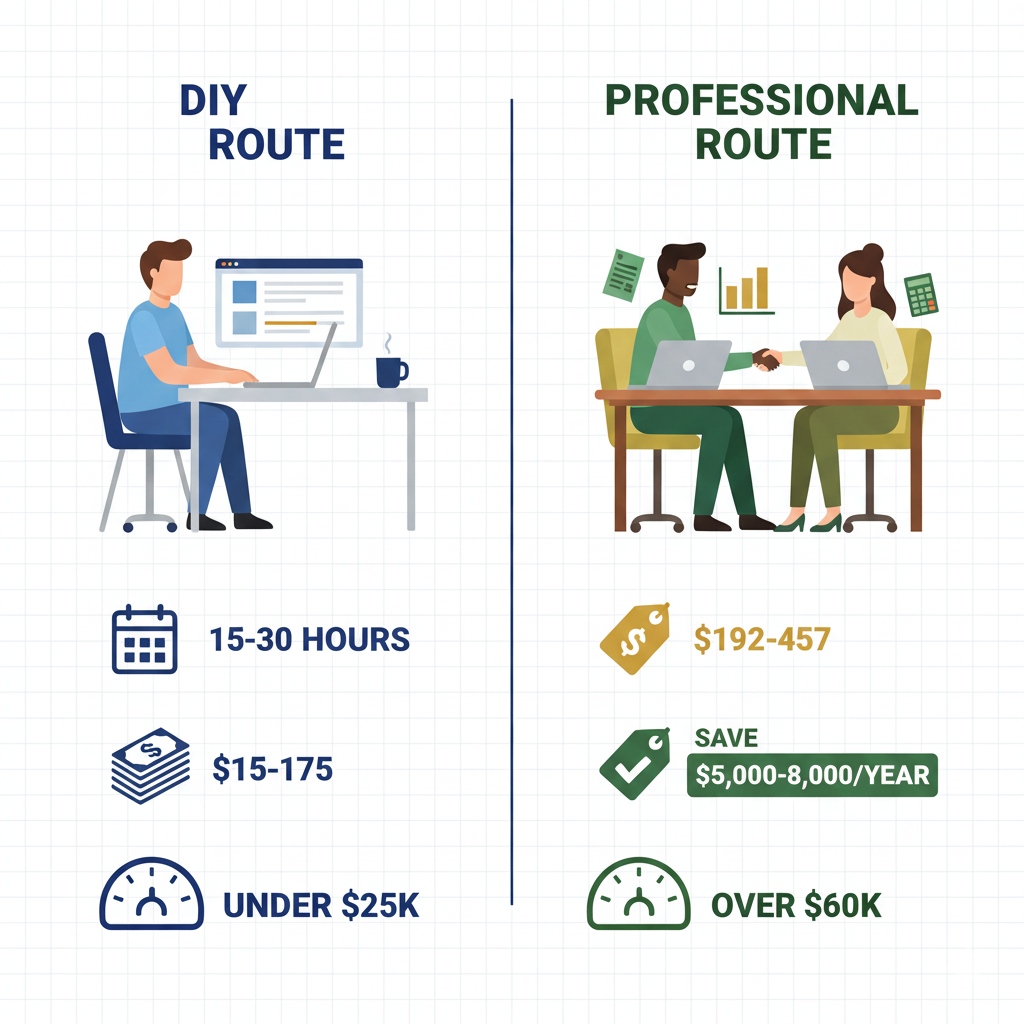
You might be good doing it yourself if you sell less than $25,000 each year. You sell on just one website like Amazon, Etsy, Walmart, or eBay. You keep good records all year long. You only sell in your home state. You don’t have employees.
Meet Sarah. She sells jewelry on Etsy. Last year she made $18,000. She bought supplies for $3,200. She paid Etsy fees of $1,100. She bought shipping boxes for $400. She used part of her home as an office for $600.
Sarah used tax software that cost $15. It took her about 10 hours to finish. She saved about $285 compared to hiring help.
Her business was simple. One website. Easy expenses. No sales tax problems. The software walked her through each step.
The Real Cost of Doing It Yourself
Doing your own taxes might cost more than you think. Not in money you spend today. But in money you lose over time.
Research shows that most people miss deductions they could take. According to tax professionals at Vault, a CPA firm, tax experts find about $840 more in savings on average compared to DIY filers. That’s real money left on the table.
For e-commerce sellers, the gap is often even bigger.
Here are things many sellers forget to deduct.
Your home office space costs $5 per square foot up to $1,500.
Website fees from Amazon, Etsy, and eBay run about 10% to 15% of your sales.
Credit card processing fees cost about 3% plus 30 cents per sale. On $100,000 in sales, that’s $3,200 you can deduct.
Product sellers make big mistakes with inventory. You can only deduct products you actually sold. Not everything you bought. Many new sellers deduct all their purchases at once. That’s wrong. It can trigger an audit.
Sales tax mistakes are serious. Very serious. Some sellers collect sales tax from customers but don’t send it to the state. States treat this as stealing. You could face criminal charges. Even honest mistakes cost 10% to 25% penalties plus interest.
Meet Marcus. He started like Sarah with $15,000 in sales. Two years later he made $120,000. He kept doing his own taxes. Big mistake.
He missed a chance to save $8,000 per year with a different business structure. He calculated inventory wrong. The IRS sent him a letter. He didn’t register for sales tax in three states. Fixing everything cost him $ $12,435 in back taxes and penalties.
When Professional Help Pays Off
Tax professionals cost more up front. But they often save you more than they cost.
A basic tax return from a CPA costs about $192 to $457. More complex returns cost $1,000 to $3,450. That sounds like a lot. But look at what you get.
The biggest savings comes from something called S-Corp election. This is a way to organize your business that saves on taxes.
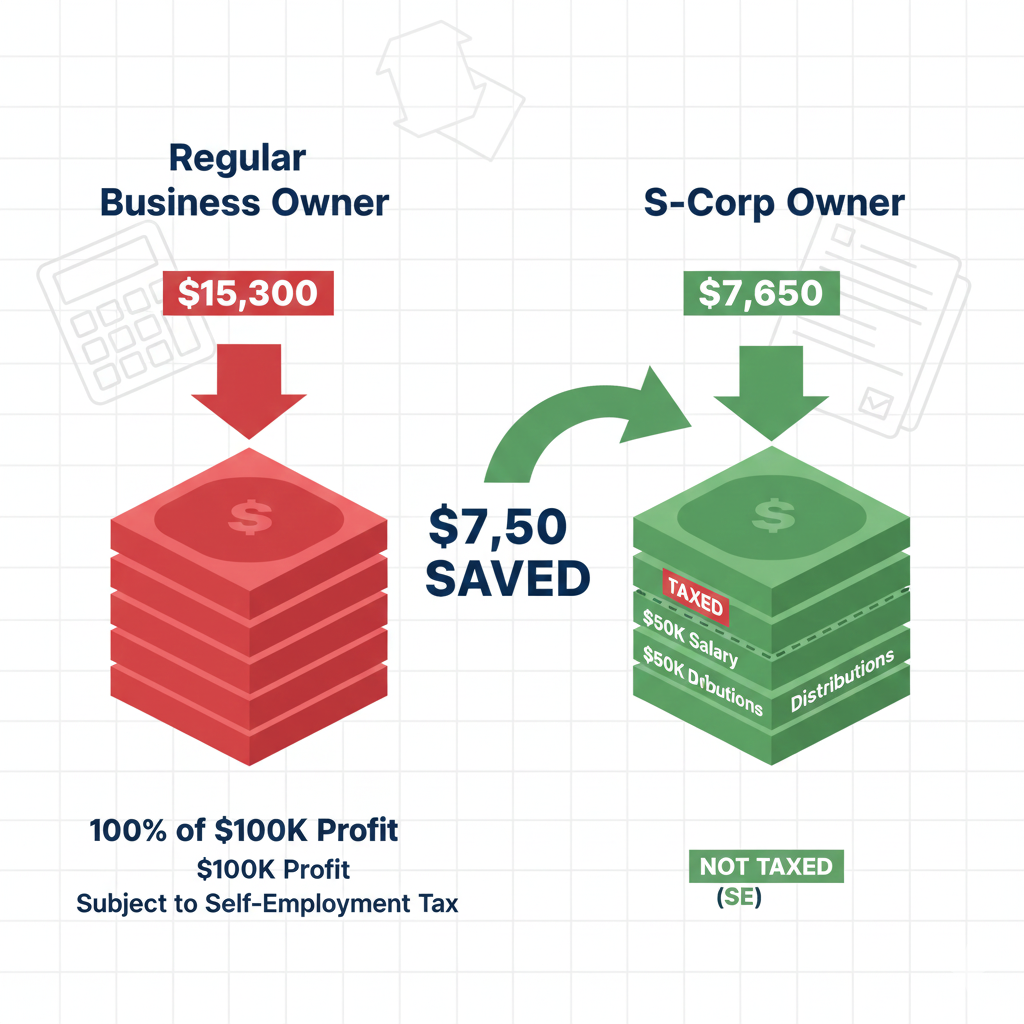
Here’s how it works. Say you make $100,000 profit. As a regular business owner, you pay about $15,300 in self-employment tax. That’s money for Social Security and Medicare.
With S-Corp status, you split your income differently. You pay yourself a salary of $50,000. You take the other $50,000 as distributions. Now you only pay $7,650 in self-employment tax. That’s a savings of $7,650 per year.
The extra accounting costs about $1,500 to $2,500 more. You still save $5,000 to $6,000 every year.
Tax software can’t do this for you. You need a real person who knows tax law.
Most tax pros say consider S-Corp when you make $60,000 to $80,000 profit. Below that, it’s not worth the extra work. Above that, you’re leaving money on the table.
New E-commerce Tax Rules for 2026
Tax rules for online sellers changed in July 2025. Congress passed a new law called the One Big Beautiful Bill Act.
The old rule said you’d get a tax form called 1099-K if you made more than $600. The new rule changed it back. Now you only get the form if you make more than $20,000 AND have more than 200 sales.
But here’s what’s important. You still owe taxes on ALL your income. Even if you don’t get the form. The IRS has computers that track everything. Don’t think you can skip reporting income.
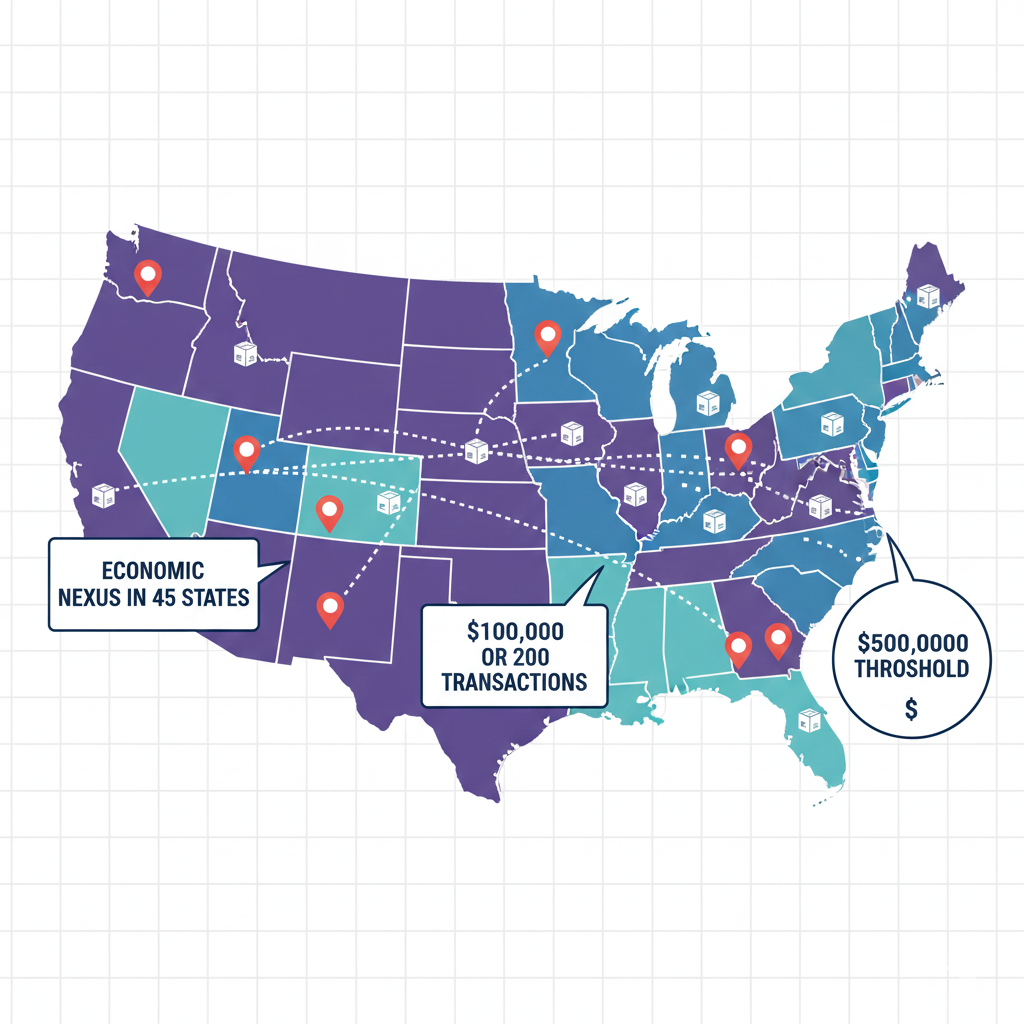
Sales tax rules also changed after a big court case in 2018. Now you might owe sales tax in many states. The common rule is $100,000 in sales OR 200 sales in that state. Hit that number and you must collect sales tax there.
Some states use different numbers. California and Texas say $500,000. Alabama and Mississippi say $250,000. You need to track sales in every state.
How to Decide What’s Right for You
Let’s make this simple. Answer these questions honestly.
How much do you make? Under $25,000 means you can probably do it yourself. Between $25,000 and $50,000 means maybe get help. Over $50,000 means seriously consider a professional. Over $75,000 means you should almost certainly hire someone.
How complicated is your business? Selling on multiple websites makes things harder. Using Amazon FBA creates tax issues in many states. Having lots of inventory is complex. Hiring people adds complexity. Accepting cryptocurrency is complicated.
How much is your time worth? Doing taxes yourself takes 15 to 30 hours. If your time is worth $50 per hour, that’s $750 to $1,500. That’s about what a professional costs anyway.
Can you answer yes to these questions? Do you know how to calculate inventory correctly? Do you know which states you owe sales tax in? Could you explain your deductions to an auditor? Are you sure you’re taking every deduction you qualify for?
If you said no to any of these, you might need help.
If You Decide to Do It Yourself
Here’s your step-by-step plan.
Keep records all year long. Don’t wait until tax time. Save every receipt. Track every expense. Use a separate bank account for business.
In January, gather your tax forms. You’ll get a 1099-K from payment processors like PayPal. Make sure the numbers match your records.
Between February and March, add up all your income and expenses. Calculate how much inventory you have left. Make sure your math is right.
You’ll need to fill out these forms. Form 1040 is your main tax return. Schedule C is for business profit and loss. Schedule SE is for self-employment tax.
If you made more than $1,000 in profit, pay estimated taxes four times per year. The due dates are April 15, June 15, September 15, and January 15.
Use tax software to make it easier. FreeTaxUSA costs $0 to $15. TurboTax costs about $139. H&R Block costs $85 to $115. They all walk you through the process.
Keep your records for at least three years. The IRS can audit you during that time.
What Happens If You Make Mistakes
Tax mistakes cost real money. Here’s what you need to know.
If you file late, you pay 5% per month of what you owe. The maximum is 25%. If you’re more than 60 days late, you pay at least $510.
If you make mistakes on your return, you might pay a 20% penalty on the amount you got wrong.
Interest adds up too. It’s about 7% per year and grows every day.
State sales tax penalties are similar. Usually 10% to 25% of what you owe. Interest ranges from 7% to 18%. If you collected tax from customers but didn’t send it to the state, you could face criminal charges.
The IRS audits more business owners than regular employees. About 2.5% of business tax returns get audited versus less than 1% of simple returns.
When to Switch to Professional Help
Some events mean you should get help right away.
Get help immediately if the IRS sends you any letter. Get help if you start making more than $100,000 in sales. Get help if you start selling on your own website instead of just marketplaces. Get help if you hire your first employee. Get help if someone mentions auditing you.
Also consider getting help if doing taxes takes more than 20 hours. Or if you feel worried about whether you’re doing it right. Or if you keep missing payment deadlines.
Look for a tax professional who knows online businesses. Many CPAs work with restaurants or doctors. They don’t understand Amazon fees or multi-state sales tax. Ask them directly how many online sellers they help.
At Tall Oak Advisors, we used to run online businesses ourselves. We sold products on Amazon. We dealt with the same tax issues you face. That’s why we understand what you’re going through.
Making Your Decision
Here’s the simple version.
If you make less than $25,000 and keep things simple, try doing it yourself. Budget $0 to $175 for software. Set aside 15 to 30 hours.
If you make between $25,000 and $60,000, think about your situation. Maybe pay for one consultation with a CPA. That costs about $200 to $400 for an hour. They can tell you if you’re on the right track.
If you make more than $60,000, hiring help almost always pays for itself. The S-Corp savings alone is usually $5,000 to $8,000 per year. Add in better deductions and audit protection, and the value is clear.
Remember that you can change your mind. Many sellers start doing their own taxes. Then they hire help as their business grows. The key is knowing when you’ve reached that point.
Get Your Free Tax Strategy Session with Tall Oak Advisors
You need to understand your specific situation. How much you make. How complicated things are. How much risk you’re comfortable with. How much your time is worth.
Tall Oak Advisors offers free 30-minute strategy sessions for online sellers. We’ll talk through your situation. No pressure to buy anything.
Maybe you’re new to Etsy and wondering about business bank accounts. Maybe you’re selling on Amazon and thinking about S-Corp status. Either way, we’re happy to help.
Our team includes Accountants who built their own online businesses. We understand fee structures because we paid those fees. We know multi-state tax issues because we dealt with them ourselves.
Schedule your free session at talloakadvisors.co/strategy. You’ll walk away knowing exactly what you need. Even if that means we tell you to keep doing it yourself for now. We want to help you make the right choice. That’s what being a real partner means.

Take Control of Your Finances Today!
Whether you’re a Reseller (Wholesale, Retail Arbitrage, Online Arbitrage, Dropshipping) or a Brand Owner, managing finances is key to your success. We support eCommerce businesses across major platforms like Amazon, Shopify, eBay, Walmart, Etsy, BigCommerce, and beyond.
See if you qualify for a free strategy session with our team to learn how Tall Oak Advisors can streamline your bookkeeping and ensure accurate tax preparation for your business.
Need a quick quote?
Or explore our range of free resources crafted specifically for eCommerce sellers:
- Business Tax Worksheet
- Frequently Asked Questions About Taxes and Bookkeeping
- Tax Write-Offs Every Amazon and Shopify Seller Should Know
Take the first step toward a stronger financial future and position your business for long-term success.
You started selling online. Now tax time is coming. Should you do your e-commerce taxes yourself or hire someone to help?
The answer depends on three things.
How much money you make.
How complicated your business is.
How much your time is worth.
Let’s break this down so you can decide.
When You Can Do Your Own E-commerce Taxes
Some sellers can handle their own taxes just fine. Are you one of them?
You might be good doing it yourself if you sell less than $25,000 each year. You sell on just one website like Amazon, Etsy, Walmart, or eBay. You keep good records all year long. You only sell in your home state. You don’t have employees.
Meet Sarah. She sells jewelry on Etsy. Last year she made $18,000. She bought supplies for $3,200. She paid Etsy fees of $1,100. She bought shipping boxes for $400. She used part of her home as an office for $600.
Sarah used tax software that cost $15. It took her about 10 hours to finish. She saved about $285 compared to hiring help.
Her business was simple. One website. Easy expenses. No sales tax problems. The software walked her through each step.
The Real Cost of Doing It Yourself
Doing your own taxes might cost more than you think. Not in money you spend today. But in money you lose over time.
Research shows that most people miss deductions they could take. According to tax professionals at Vault, a CPA firm, tax experts find about $840 more in savings on average compared to DIY filers. That’s real money left on the table.
For e-commerce sellers, the gap is often even bigger.
Here are things many sellers forget to deduct.
Your home office space costs $5 per square foot up to $1,500.
Website fees from Amazon, Etsy, and eBay run about 10% to 15% of your sales.
Credit card processing fees cost about 3% plus 30 cents per sale. On $100,000 in sales, that’s $3,200 you can deduct.
Product sellers make big mistakes with inventory. You can only deduct products you actually sold. Not everything you bought. Many new sellers deduct all their purchases at once. That’s wrong. It can trigger an audit.
Sales tax mistakes are serious. Very serious. Some sellers collect sales tax from customers but don’t send it to the state. States treat this as stealing. You could face criminal charges. Even honest mistakes cost 10% to 25% penalties plus interest.
Meet Marcus. He started like Sarah with $15,000 in sales. Two years later he made $120,000. He kept doing his own taxes. Big mistake.
He missed a chance to save $8,000 per year with a different business structure. He calculated inventory wrong. The IRS sent him a letter. He didn’t register for sales tax in three states. Fixing everything cost him $ $12,435 in back taxes and penalties.
When Professional Help Pays Off
Tax professionals cost more up front. But they often save you more than they cost.
A basic tax return from a CPA costs about $192 to $457. More complex returns cost $1,000 to $3,450. That sounds like a lot. But look at what you get.
The biggest savings comes from something called S-Corp election. This is a way to organize your business that saves on taxes.
Here’s how it works. Say you make $100,000 profit. As a regular business owner, you pay about $15,300 in self-employment tax. That’s money for Social Security and Medicare.
With S-Corp status, you split your income differently. You pay yourself a salary of $50,000. You take the other $50,000 as distributions. Now you only pay $7,650 in self-employment tax. That’s a savings of $7,650 per year.
The extra accounting costs about $1,500 to $2,500 more. You still save $5,000 to $6,000 every year.
Tax software can’t do this for you. You need a real person who knows tax law.
Most tax pros say consider S-Corp when you make $60,000 to $80,000 profit. Below that, it’s not worth the extra work. Above that, you’re leaving money on the table.
New E-commerce Tax Rules for 2026
Tax rules for online sellers changed in July 2025. Congress passed a new law called the One Big Beautiful Bill Act.
The old rule said you’d get a tax form called 1099-K if you made more than $600. The new rule changed it back. Now you only get the form if you make more than $20,000 AND have more than 200 sales.
But here’s what’s important. You still owe taxes on ALL your income. Even if you don’t get the form. The IRS has computers that track everything. Don’t think you can skip reporting income.
Sales tax rules also changed after a big court case in 2018. Now you might owe sales tax in many states. The common rule is $100,000 in sales OR 200 sales in that state. Hit that number and you must collect sales tax there.
Some states use different numbers. California and Texas say $500,000. Alabama and Mississippi say $250,000. You need to track sales in every state.
How to Decide What’s Right for You
Let’s make this simple. Answer these questions honestly.
How much do you make? Under $25,000 means you can probably do it yourself. Between $25,000 and $50,000 means maybe get help. Over $50,000 means seriously consider a professional. Over $75,000 means you should almost certainly hire someone.
How complicated is your business? Selling on multiple websites makes things harder. Using Amazon FBA creates tax issues in many states. Having lots of inventory is complex. Hiring people adds complexity. Accepting cryptocurrency is complicated.
How much is your time worth? Doing taxes yourself takes 15 to 30 hours. If your time is worth $50 per hour, that’s $750 to $1,500. That’s about what a professional costs anyway.
Can you answer yes to these questions? Do you know how to calculate inventory correctly? Do you know which states you owe sales tax in? Could you explain your deductions to an auditor? Are you sure you’re taking every deduction you qualify for?
If you said no to any of these, you might need help.
If You Decide to Do It Yourself
Here’s your step-by-step plan.
Keep records all year long. Don’t wait until tax time. Save every receipt. Track every expense. Use a separate bank account for business.
In January, gather your tax forms. You’ll get a 1099-K from payment processors like PayPal. Make sure the numbers match your records.
Between February and March, add up all your income and expenses. Calculate how much inventory you have left. Make sure your math is right.
You’ll need to fill out these forms. Form 1040 is your main tax return. Schedule C is for business profit and loss. Schedule SE is for self-employment tax.
If you made more than $1,000 in profit, pay estimated taxes four times per year. The due dates are April 15, June 15, September 15, and January 15.
Use tax software to make it easier. FreeTaxUSA costs $0 to $15. TurboTax costs about $139. H&R Block costs $85 to $115. They all walk you through the process.
Keep your records for at least three years. The IRS can audit you during that time.
What Happens If You Make Mistakes
Tax mistakes cost real money. Here’s what you need to know.
If you file late, you pay 5% per month of what you owe. The maximum is 25%. If you’re more than 60 days late, you pay at least $510.
If you make mistakes on your return, you might pay a 20% penalty on the amount you got wrong.
Interest adds up too. It’s about 7% per year and grows every day.
State sales tax penalties are similar. Usually 10% to 25% of what you owe. Interest ranges from 7% to 18%. If you collected tax from customers but didn’t send it to the state, you could face criminal charges.
The IRS audits more business owners than regular employees. About 2.5% of business tax returns get audited versus less than 1% of simple returns.
When to Switch to Professional Help
Some events mean you should get help right away.
Get help immediately if the IRS sends you any letter. Get help if you start making more than $100,000 in sales. Get help if you start selling on your own website instead of just marketplaces. Get help if you hire your first employee. Get help if someone mentions auditing you.
Also consider getting help if doing taxes takes more than 20 hours. Or if you feel worried about whether you’re doing it right. Or if you keep missing payment deadlines.
Look for a tax professional who knows online businesses. Many CPAs work with restaurants or doctors. They don’t understand Amazon fees or multi-state sales tax. Ask them directly how many online sellers they help.
At Tall Oak Advisors, we used to run online businesses ourselves. We sold products on Amazon. We dealt with the same tax issues you face. That’s why we understand what you’re going through.
Making Your Decision
Here’s the simple version.
If you make less than $25,000 and keep things simple, try doing it yourself. Budget $0 to $175 for software. Set aside 15 to 30 hours.
If you make between $25,000 and $60,000, think about your situation. Maybe pay for one consultation with a CPA. That costs about $200 to $400 for an hour. They can tell you if you’re on the right track.
If you make more than $60,000, hiring help almost always pays for itself. The S-Corp savings alone is usually $5,000 to $8,000 per year. Add in better deductions and audit protection, and the value is clear.
Remember that you can change your mind. Many sellers start doing their own taxes. Then they hire help as their business grows. The key is knowing when you’ve reached that point.
Get Your Free Tax Strategy Session with Tall Oak Advisors
You need to understand your specific situation. How much you make. How complicated things are. How much risk you’re comfortable with. How much your time is worth.
Tall Oak Advisors offers free 30-minute strategy sessions for online sellers. We’ll talk through your situation. No pressure to buy anything.
Maybe you’re new to Etsy and wondering about business bank accounts. Maybe you’re selling on Amazon and thinking about S-Corp status. Either way, we’re happy to help.
Our team includes Accountants who built their own online businesses. We understand fee structures because we paid those fees. We know multi-state tax issues because we dealt with them ourselves.
Schedule your free session at talloakadvisors.co/strategy. You’ll walk away knowing exactly what you need. Even if that means we tell you to keep doing it yourself for now. We want to help you make the right choice. That’s what being a real partner means.
Take Control of Your Finances Today!
Whether you’re a Reseller (Wholesale, Retail Arbitrage, Online Arbitrage, Dropshipping) or a Brand Owner, managing finances is key to your success. We support eCommerce businesses across major platforms like Amazon, Shopify, eBay, Walmart, Etsy, BigCommerce, and beyond.
See if you qualify for a free strategy session with our team to learn how Tall Oak Advisors can streamline your bookkeeping and ensure accurate tax preparation for your business.
Need a quick quote?
Or explore our range of free resources crafted specifically for eCommerce sellers:
- 7 Profit Crushing Mistakes That Will Destroy Your eCommerce Business
- Business Tax Worksheet
- Frequently Asked Questions About Taxes and Bookkeeping
- Tax Write-Offs Every Amazon and Shopify Seller Should Know
Take the first step toward a stronger financial future and position your business for long-term success.