

READ YOUR BUSINESS SERIES | A Monthly Financial Guide for E-Commerce Entrepreneurs | Article 3 of 5
So far in this series, we have covered two reports that focus on activity — what your business earned, what it spent, and how cash moved in and out over time. Those reports tell a story in motion.
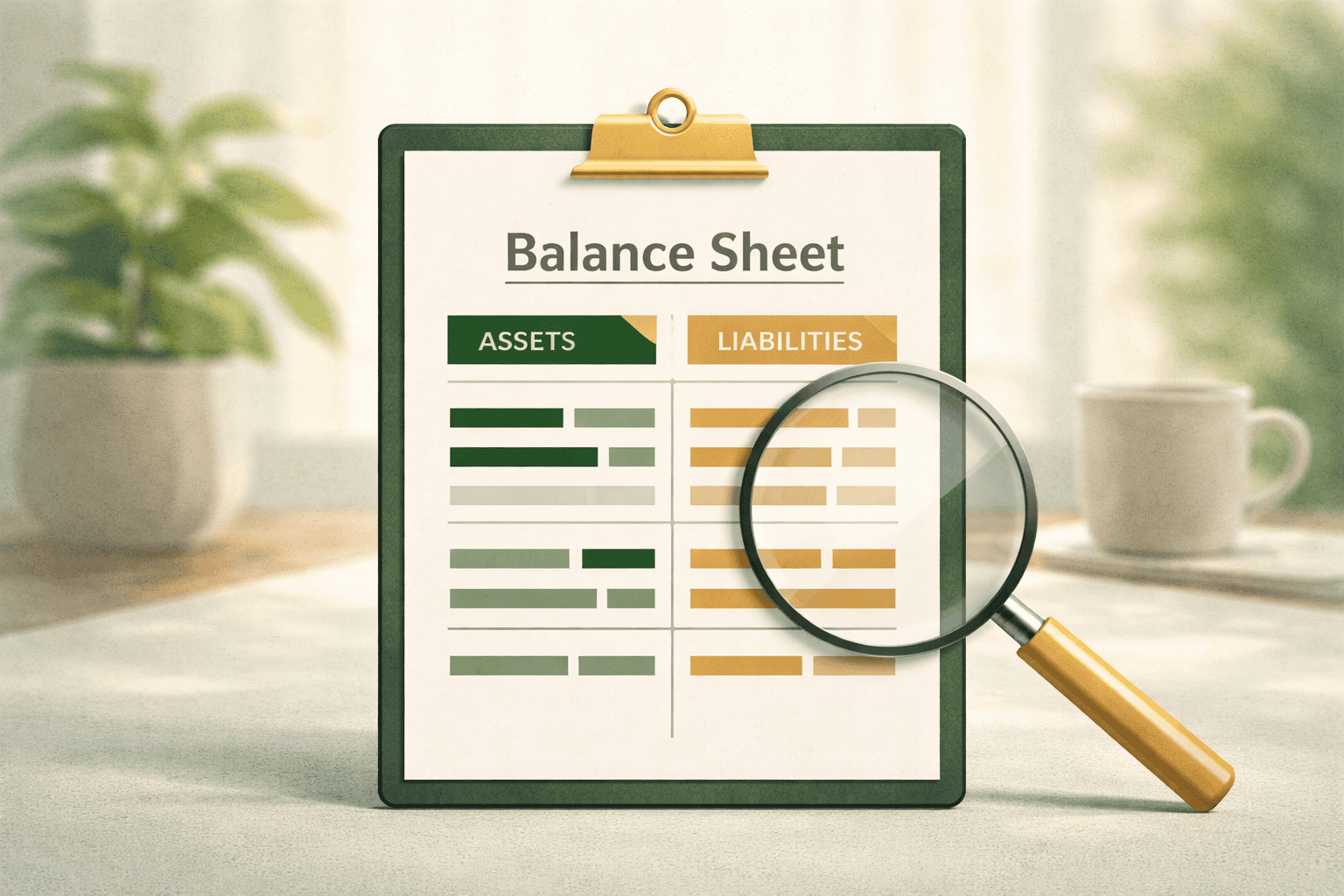
The Balance Sheet is different. It is a still frame. It shows you exactly where your business stands at one specific point in time — usually the last day of the month. Everything your business owns, everything it owes, and what is left over once you subtract one from the other.
It is also the most underused report in e-commerce because reviewed monthly, the balance sheet tells you things the P&L and cash flow statement simply cannot.
The Three Parts of a Balance Sheet
Every balance sheet is built around one equation:
Assets = Liabilities + Owner’s Equity
That equation always has to balance — which is where the report gets its name. Here is what each piece means for your business:
- Assets: Everything your business owns or is owed. Cash in your bank account, inventory on hand, money platforms owe you in pending payouts, equipment, and prepaid expenses all count as assets.
- Liabilities: Everything your business owes to others. Supplier invoices you have not paid yet, loans, credit card balances, capital advances, and sales tax you have collected but not yet remitted are all liabilities.
- Owner’s Equity: What is left over after you subtract liabilities from assets. This is the net value of your business — the portion that actually belongs to you.
Each month, as your business earns profit and reinvests it, your equity should grow. Watching that number trend upward over time is one of the most meaningful indicators that you are building something real.
What to Look at Every Month
1. Your Inventory Balance
For e-commerce businesses, inventory is often the largest asset on the balance sheet — and one of the most important to watch closely. Is your inventory value growing month over month even though your sales are staying flat? That is a signal worth investigating. It usually means products are sitting longer than expected, which ties up cash and can quietly inflate your assets on paper while your actual liquidity shrinks.
On the flip side, if your inventory balance is dropping faster than your sales volume would explain, you may have a stockout pattern developing — missed sales you are not even seeing because the products simply were not available. Both directions tell you something important about how your inventory is being managed.
2. Accounts Payable
This is what you owe to suppliers and vendors. A healthy accounts payable balance is normal — it means you are using credit terms wisely. But if this number is growing steadily while your revenue is flat, it may mean cash flow pressure is causing you to delay payments longer than planned. That is useful to know, and it is something your balance sheet will surface before it becomes a problem.
3. Outstanding Platform Payouts
Money that platforms owe you — pending Amazon disbursements, Shopify payouts in transit, PayPal reserve balances — should appear as an asset on your balance sheet, not disappear from your records until it lands in your bank. If your bookkeeping is set up correctly, you will see this as accounts receivable or a platform-specific asset account. If you do not see it, it is worth asking your bookkeeper where those funds are being recorded.
4. Loans and Capital Advances
Every credit line, Amazon Lending draw, Shopify Capital advance, or business loan should have its own liability line on the balance sheet. It is easy to lose track of total debt when advances come from multiple platforms at different times. Your balance sheet is the one place where all of it lives together, giving you a clear picture of your total obligations at any given moment.
5. Owner’s Equity Trend
Pull up your balance sheet from three months ago and compare it to today. Is your equity growing? If your business is profitable and you are reinvesting appropriately, it should be. If equity is shrinking despite positive P&L results, there is usually a story in the liabilities section — debt accumulation, owner withdrawals, or timing differences in how transactions are being recorded.
The Inventory Accuracy Question
There is something worth paying attention to as you review your balance sheet each month: the inventory number on your balance sheet is only as accurate as the records behind it.
Accounting software tracks inventory based on the transactions that have been entered. But if returns are not being adjusted correctly, if FBA inventory counts have drifted from your books, or if damaged or unsellable items have not been written off, your balance sheet inventory figure may be higher than what you actually have. That overstates your assets and can also distort your cost of goods sold.
A periodic physical count — or a reconciliation between your accounting software and your platform inventory reports — is one of the best ways to keep this number honest. It does not need to happen every month, but doing it quarterly goes a long way toward keeping your balance sheet accurate.
Good to know: If you are an Amazon FBA seller, your inventory is physically held across multiple fulfillment centers. Your balance sheet should reflect the total value of all FBA inventory — not just what is in transit or recently shipped. Tools like A2X or Sellerboard can help sync that data to your accounting software so the balance sheet stays current.
How the Balance Sheet Connects to Your Taxes
A few balance sheet items have direct tax implications that are worth keeping in mind throughout the year.
Inventory valuation on your balance sheet feeds directly into your cost of goods sold calculation, which is typically one of the largest deductions on your tax return. The method you use to value inventory — FIFO (first in, first out), average cost, or another approach — needs to be applied consistently from year to year. Changing methods without proper documentation and IRS approval can raise questions during a review.
Sales tax you have collected but not yet remitted also sits on your balance sheet as a liability. This is money that was never yours to keep — it belongs to the state. Keeping this balance visible and accurate makes it much easier to file and remit on time, and ensures you are not accidentally treating collected sales tax as available business cash.
A note on equity and owner’s draws: If you take money out of the business — whether as a salary, a distribution, or an owner’s draw — it reduces your equity on the balance sheet. Keeping personal and business finances clearly separated, and recording any withdrawals accurately, is important both for clean bookkeeping and for making sure your tax picture is accurate at year end.
Getting Started This Month
If you have been following along with Articles 1 and 2, you are already pulling your P&L and cash flow statement each month. Adding the balance sheet to that review takes just a few extra minutes. Here is what to focus on:
- Pull your balance sheet as of the last day of the prior month from QuickBooks or Xero.
- Check your inventory balance and compare it to the prior month. Is the trend consistent with your sales activity?
- Review your total liabilities. Do you have a clear understanding of every balance listed there?
- Look at your owner’s equity. Is it higher than it was three months ago?
- Confirm that any platform reserve balances or pending payouts are showing up as assets, not missing from the report entirely.
You do not need to analyze every line in detail every month. The goal is to get familiar with the shape of your balance sheet — so that when something shifts, you notice it.
You Do Not Have to Do This Alone
If getting your balance sheet set up correctly — with inventory properly synced, liabilities clearly categorized, and equity accurately reflected — feels like a project you do not have time to tackle right now, that is a great reason to reach out. At Tall Oak Advisors, we help e-commerce sellers build the financial foundation that makes reports like this useful and trustworthy every single month. Whether you need a one-time clean-up or ongoing monthly support, we would love to help. Reach out here and let’s talk about where to start.
Coming Up Next
In Article 4 of the Read Your Business series, we are tackling the Sales Tax Liability Report — one of the most misunderstood and underreviewed reports for e-commerce sellers. If you sell across multiple states or channels, this one is especially important. We will walk through economic nexus, marketplace facilitator rules, and how to know whether your current setup is keeping you compliant.
Have questions about your balance sheet or want a second set of eyes on your numbers? Tall Oak Advisors is always happy to help — reach out any time.
Take Control of Your Finances Today!
Whether you’re a Reseller (Wholesale, Retail Arbitrage, Online Arbitrage, Dropshipping) or a Brand Owner, managing finances is key to your success. We support eCommerce businesses across major platforms like Amazon, Shopify, eBay, Walmart, Etsy, BigCommerce, and beyond.
See if you qualify for a free strategy session with our team to learn how Tall Oak Advisors can streamline your bookkeeping and ensure accurate tax preparation for your business.
Need a quick quote?
Or explore our range of free resources crafted specifically for eCommerce sellers:
- Business Tax Worksheet
- Frequently Asked Questions About Taxes and Bookkeeping
- Tax Write-Offs Every Amazon and Shopify Seller Should Know
Take the first step toward a stronger financial future and position your business for long-term success.
READ YOUR BUSINESS SERIES | A Monthly Financial Guide for E-Commerce Entrepreneurs | Article 3 of 5
So far in this series, we have covered two reports that focus on activity — what your business earned, what it spent, and how cash moved in and out over time. Those reports tell a story in motion.
The Balance Sheet is different. It is a still frame. It shows you exactly where your business stands at one specific point in time — usually the last day of the month. Everything your business owns, everything it owes, and what is left over once you subtract one from the other.
It is also the most underused report in e-commerce because reviewed monthly, the balance sheet tells you things the P&L and cash flow statement simply cannot.
The Three Parts of a Balance Sheet
Every balance sheet is built around one equation:
Assets = Liabilities + Owner’s Equity
That equation always has to balance — which is where the report gets its name. Here is what each piece means for your business:
- Assets: Everything your business owns or is owed. Cash in your bank account, inventory on hand, money platforms owe you in pending payouts, equipment, and prepaid expenses all count as assets.
- Liabilities: Everything your business owes to others. Supplier invoices you have not paid yet, loans, credit card balances, capital advances, and sales tax you have collected but not yet remitted are all liabilities.
- Owner’s Equity: What is left over after you subtract liabilities from assets. This is the net value of your business — the portion that actually belongs to you.
Each month, as your business earns profit and reinvests it, your equity should grow. Watching that number trend upward over time is one of the most meaningful indicators that you are building something real.
What to Look at Every Month
1. Your Inventory Balance
For e-commerce businesses, inventory is often the largest asset on the balance sheet — and one of the most important to watch closely. Is your inventory value growing month over month even though your sales are staying flat? That is a signal worth investigating. It usually means products are sitting longer than expected, which ties up cash and can quietly inflate your assets on paper while your actual liquidity shrinks.
On the flip side, if your inventory balance is dropping faster than your sales volume would explain, you may have a stockout pattern developing — missed sales you are not even seeing because the products simply were not available. Both directions tell you something important about how your inventory is being managed.
2. Accounts Payable
This is what you owe to suppliers and vendors. A healthy accounts payable balance is normal — it means you are using credit terms wisely. But if this number is growing steadily while your revenue is flat, it may mean cash flow pressure is causing you to delay payments longer than planned. That is useful to know, and it is something your balance sheet will surface before it becomes a problem.
3. Outstanding Platform Payouts
Money that platforms owe you — pending Amazon disbursements, Shopify payouts in transit, PayPal reserve balances — should appear as an asset on your balance sheet, not disappear from your records until it lands in your bank. If your bookkeeping is set up correctly, you will see this as accounts receivable or a platform-specific asset account. If you do not see it, it is worth asking your bookkeeper where those funds are being recorded.
4. Loans and Capital Advances
Every credit line, Amazon Lending draw, Shopify Capital advance, or business loan should have its own liability line on the balance sheet. It is easy to lose track of total debt when advances come from multiple platforms at different times. Your balance sheet is the one place where all of it lives together, giving you a clear picture of your total obligations at any given moment.
5. Owner’s Equity Trend
Pull up your balance sheet from three months ago and compare it to today. Is your equity growing? If your business is profitable and you are reinvesting appropriately, it should be. If equity is shrinking despite positive P&L results, there is usually a story in the liabilities section — debt accumulation, owner withdrawals, or timing differences in how transactions are being recorded.
The Inventory Accuracy Question
There is something worth paying attention to as you review your balance sheet each month: the inventory number on your balance sheet is only as accurate as the records behind it.
Accounting software tracks inventory based on the transactions that have been entered. But if returns are not being adjusted correctly, if FBA inventory counts have drifted from your books, or if damaged or unsellable items have not been written off, your balance sheet inventory figure may be higher than what you actually have. That overstates your assets and can also distort your cost of goods sold.
A periodic physical count — or a reconciliation between your accounting software and your platform inventory reports — is one of the best ways to keep this number honest. It does not need to happen every month, but doing it quarterly goes a long way toward keeping your balance sheet accurate.
Good to know: If you are an Amazon FBA seller, your inventory is physically held across multiple fulfillment centers. Your balance sheet should reflect the total value of all FBA inventory — not just what is in transit or recently shipped. Tools like A2X or Sellerboard can help sync that data to your accounting software so the balance sheet stays current.
How the Balance Sheet Connects to Your Taxes
A few balance sheet items have direct tax implications that are worth keeping in mind throughout the year.
Inventory valuation on your balance sheet feeds directly into your cost of goods sold calculation, which is typically one of the largest deductions on your tax return. The method you use to value inventory — FIFO (first in, first out), average cost, or another approach — needs to be applied consistently from year to year. Changing methods without proper documentation and IRS approval can raise questions during a review.
Sales tax you have collected but not yet remitted also sits on your balance sheet as a liability. This is money that was never yours to keep — it belongs to the state. Keeping this balance visible and accurate makes it much easier to file and remit on time, and ensures you are not accidentally treating collected sales tax as available business cash.
A note on equity and owner’s draws: If you take money out of the business — whether as a salary, a distribution, or an owner’s draw — it reduces your equity on the balance sheet. Keeping personal and business finances clearly separated, and recording any withdrawals accurately, is important both for clean bookkeeping and for making sure your tax picture is accurate at year end.
Getting Started This Month
If you have been following along with Articles 1 and 2, you are already pulling your P&L and cash flow statement each month. Adding the balance sheet to that review takes just a few extra minutes. Here is what to focus on:
- Pull your balance sheet as of the last day of the prior month from QuickBooks or Xero.
- Check your inventory balance and compare it to the prior month. Is the trend consistent with your sales activity?
- Review your total liabilities. Do you have a clear understanding of every balance listed there?
- Look at your owner’s equity. Is it higher than it was three months ago?
- Confirm that any platform reserve balances or pending payouts are showing up as assets, not missing from the report entirely.
You do not need to analyze every line in detail every month. The goal is to get familiar with the shape of your balance sheet — so that when something shifts, you notice it.
You Do Not Have to Do This Alone
If getting your balance sheet set up correctly — with inventory properly synced, liabilities clearly categorized, and equity accurately reflected — feels like a project you do not have time to tackle right now, that is a great reason to reach out. At Tall Oak Advisors, we help e-commerce sellers build the financial foundation that makes reports like this useful and trustworthy every single month. Whether you need a one-time clean-up or ongoing monthly support, we would love to help. Reach out here and let’s talk about where to start.
Coming Up Next
In Article 4 of the Read Your Business series, we are tackling the Sales Tax Liability Report — one of the most misunderstood and underreviewed reports for e-commerce sellers. If you sell across multiple states or channels, this one is especially important. We will walk through economic nexus, marketplace facilitator rules, and how to know whether your current setup is keeping you compliant.
Have questions about your balance sheet or want a second set of eyes on your numbers? Tall Oak Advisors is always happy to help — reach out any time.
Take Control of Your Finances Today!
Whether you’re a Reseller (Wholesale, Retail Arbitrage, Online Arbitrage, Dropshipping) or a Brand Owner, managing finances is key to your success. We support eCommerce businesses across major platforms like Amazon, Shopify, eBay, Walmart, Etsy, BigCommerce, and beyond.
See if you qualify for a free strategy session with our team to learn how Tall Oak Advisors can streamline your bookkeeping and ensure accurate tax preparation for your business.
Need a quick quote?
Or explore our range of free resources crafted specifically for eCommerce sellers:
- 7 Profit Crushing Mistakes That Will Destroy Your eCommerce Business
- Business Tax Worksheet
- Frequently Asked Questions About Taxes and Bookkeeping
- Tax Write-Offs Every Amazon and Shopify Seller Should Know
Take the first step toward a stronger financial future and position your business for long-term success.