

FIFO vs LIFO: one checkbox. 25% tax difference.
Most sellers just pick whatever their software defaults to.
But that one click could cost you thousandsor lock you into IRS penalties.
Here’s the truth: most online sellers should use FIFO. It’s simple. It works with most software. It’s legal everywhere in the world.
LIFO can save taxes. But it’s hard to set up. It needs IRS approval. Many countries don’t allow it.
Let’s break this down in simple terms.
What Are These Methods?
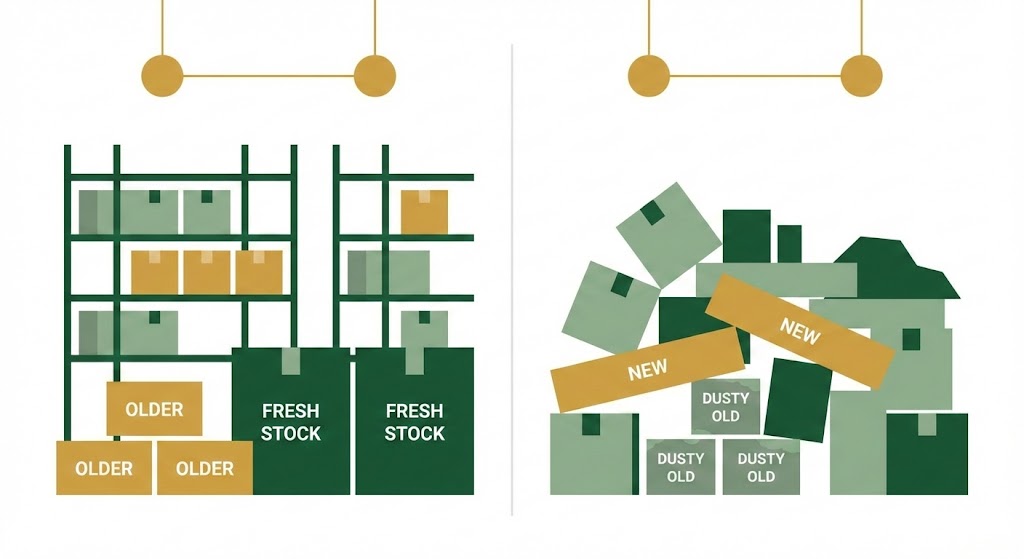
Think of a stack of boxes in your garage.
FIFO means “First In, First Out. The oldest box leaves first. You sell what you bought first. This is how most people think about inventory. You don’t want old stuff sitting around.
LIFO means “Last In, First Out. The newest box leaves first. You sell what you bought last. The old boxes stay at the bottom. This seems odd. But it can lower your taxes.

A Simple Example
Let’s say you sell t-shirts online.
In March, you buy shirts twice:
- March 5: You buy 100 shirts. Each costs $50. Total: $5,000.
- March 15: You buy 150 more shirts. Each costs $54. Total: $8,100.
- March 25: You sell 120 shirts.
Now, what did those 120 shirts cost you?
With FIFO: You sold the old shirts first. So you sold all 100 shirts at $50. That’s $5,000. Then you sold 20 more at $54. That’s $1,080. Your total cost is $6,080.
With LIFO: You sold the new shirts first. All 120 came from the $54 batch. Your total cost is $6,480.
The difference is $400. With LIFO, your costs look higher. So your profit looks lower. Lower profit means lower taxes.
This was just 250 shirts. Imagine thousands of products. The savings add up fast.

Why Prices Going Up Matters
When prices rise, LIFO saves more taxes.
Here’s another example. An Amazon seller buys phone cases:
- First order: 100 cases at $5 each
- Second order: 200 cases at $7 each
- Sold: 150 cases
With FIFO: Cost = (100 × $5) + (50 × $7) = $850
With LIFO: Cost = (150 × $7) = $1,050
LIFO shows costs that are 24% higher. That means 24% less profit on paper. And less taxes to pay.
Over time, this adds up. A business with $1,000,000 in inventory might save $42,000 in taxes by using LIFO.
But there’s a catch. LIFO is hard to use.
The IRS Rules You Must Know
The IRS is the tax agency. They have rules about inventory.
Rule 1: Pick one method and stick with it. You can’t switch back and forth. You can’t use FIFO one year and LIFO the next. The IRS won’t allow it.
Rule 2: LIFO requires matching. If you use LIFO for taxes, you must use it for all reports. You can’t tell the IRS one thing. And tell your bank another. This is called the “conformity rule.”
Rule 3: Small businesses get a break. If your sales are under $31 million per year (in 2025), you have simpler options. You may not need fancy inventory tracking at all.
Rule 4: LIFO needs a special form. You must file Form 970. This goes with your first tax return using LIFO. Miss this form? Your LIFO election is invalid.
Rule 5: Changing methods costs money. Want to switch methods later? You need Form 3115. The IRS fee is $43,700 in 2025. Yes, really.
Why Most Online Sellers Choose FIFO
FIFO is easier for many reasons.
It matches reality. You probably sell old stock first. This keeps products fresh. It prevents items from sitting too long.
Software does it for you. QuickBooks uses FIFO. So does Xero. Most e-commerce tools use FIFO by default.
It works worldwide. Planning to sell in other countries? LIFO is banned in most of the world. Europe, Asia, Australia—they all require FIFO or average cost.
Banks like it. FIFO makes your inventory look more valuable. This helps when you need a loan.
About 93% of big U.S. companies use FIFO or average cost. Only 7% use LIFO. And that number keeps shrinking.

What About Amazon FBA Sellers?
Selling on Amazon adds some twists.
Amazon stores your products in warehouses across the country. When a customer orders, Amazon ships from the nearest warehouse. They don’t check which items arrived first.
Does this matter for accounting? Not really. Your accounting method tracks costs on paper. It doesn’t have to match how products physically move.
Most Amazon seller accountants suggest “average cost.” This is even simpler than FIFO.
With average cost, you add up all your inventory costs. Then divide by the number of items. Every item has the same cost.
Example:
- You have 100 items that cost $10 each = $1,000
- You buy 200 more at $12 each = $2,400
- Total: 300 items, $3,400 in costs
- Average cost = $3,400 ÷ 300 = $11.33 per item
Every sale uses $11.33 as the cost. No tracking of old vs. new batches.
FBA fees complicate things too. You pay Amazon for storage, shipping, and handling. These fees should be part of your inventory cost. Good accounting software tracks this.
Returns need attention. When customers return items, you need to adjust your records. The sale goes away. The inventory comes back.
How to Set Up FIFO Tracking
Setting up FIFO is not hard. Here are the steps.
Step 1: Turn on inventory tracking. In QuickBooks, go to Settings. Find “Products and Services.” Turn on “Track inventory.” FIFO starts automatically.
Step 2: Record every purchase. Write down the date, the number of items, and the cost. Keep invoices. Keep receipts. Every time you get products, log it.
Step 3: Label your batches. Put dates on boxes. Use stickers or labels. This helps you ship old items first. It also helps if you need to look back at records.
Step 4: Check your counts. At least every three months, count your actual inventory. Compare it to what your software says. Fix any differences.
Step 5: Keep records for years. The IRS says keep records for at least 3 years. But 6 years is safer. Some records should be kept forever.

Common Mistakes to Avoid
People mess up inventory accounting in these ways.
Mistake 1: Not tracking cost layers. FIFO needs you to know: “I bought 50 at $10, then 30 at $12.” If you only track totals, you can’t do FIFO right.
Mistake 2: Using LIFO without following the rules. Some people use LIFO for taxes but show FIFO numbers to banks. This breaks the conformity rule. If caught, you lose your LIFO status. You might owe years of back taxes.
Mistake 3: Switching methods without permission. You can’t just change from FIFO to LIFO (or back). You need IRS approval.
Mistake 4: Forgetting the paperwork. LIFO requires Form 970 the first year. Skip this form? Your LIFO election doesn’t count.
Mistake 5: Running out of LIFO inventory. With LIFO, old cheap inventory sits at the bottom forever. What if you sell more than usual and dig into that old inventory? Suddenly your costs look very low. Your profits spike. Your taxes spike. This surprise can hurt.
Mistake 6: Sloppy year-end cutoffs. Did that shipment arrive December 31 or January 1? Getting this wrong puts costs in the wrong year.
Mistake 7: Mixing methods without care. You can use FIFO for one product line and average cost for another. But you need clear records. And it gets confusing fast.
Mistake 8: Not planning for business changes. What if your C-corp becomes an S-corp? LIFO creates a tax bill when you do this. Plan ahead.

How to Choose Your Method
Here is a simple guide.
Choose FIFO if:
- You sell food, fashion, or anything that goes stale or out of style
- You might sell outside the U.S.
- You want things simple
- You might seek investors or loans
- Your accounting software uses FIFO
Choose average cost if:
- You’re an Amazon FBA seller
- You don’t have accounting staff
- You sell lots of similar, low-cost items
- You want the easiest option
Think about LIFO only if:
- You sell only in the U.S.
- Your products don’t go bad or out of style
- Prices keep going up year after year
- You have a good accountant to manage it
- You keep plenty of inventory on hand
For most online sellers, FIFO or average cost is the right choice. The tax savings from LIFO rarely outweigh the headaches.
How Long to Keep Records
The IRS has rules about keeping paperwork.
Basic rule: 3 years. Keep records for 3 years after you file your tax return.
Longer rule: 6 years. If you made a big mistake on your taxes (underreported by more than 25%), the IRS has 6 years to check.
Forever rule. If you use LIFO, keep those records forever. The IRS can check them anytime.
What to keep: Purchase orders, invoices, receipts, inventory counts, sales records. Keep digital copies. Back them up.
State Taxes Add Complexity
Different states have different rules.
Most states follow federal tax rules. If you use FIFO for federal taxes, you use FIFO for state taxes.
But some states are different. Texas has its own inventory rules for its franchise tax. Some states tax inventory as property.
Talk to a tax pro who knows your state.

When to Get Help
Some situations need expert help:
- Starting a new business? Talk to an accountant before your first year ends.
- Thinking about LIFO? Get professional advice first.
- Selling internationally? Make sure your method works everywhere.
- Inventory over $100,000? Professional guidance pays for itself.
- Planning to sell your business? Your inventory method affects the sale price.
Ready to Get Your Inventory Accounting Right?
Choosing between FIFO, LIFO, and average cost is just one piece of the puzzle. E-commerce accounting has layers that most general accountants don’t fully understand, from Amazon FBA fee allocation to multi-state sales tax to the unique cash flow patterns of online sellers.
At Tall Oak Advisors, we specialize in helping e-commerce entrepreneurs navigate these complexities. We speak your language, whether you’re an Amazon FBA seller scaling to seven figures or a Shopify store owner trying to make sense of your numbers.
Don’t let inventory accounting mistakes cost you money or trigger an audit. Reach out to our team today for a consultation, and let’s make sure your books are set up for success from day one.
This article is for information only. It is not tax advice. Talk to a qualified accountant or tax advisor about your specific situation.
Take Control of Your Finances Today!
Whether you’re a Reseller (Wholesale, Retail Arbitrage, Online Arbitrage, Dropshipping) or a Brand Owner, managing finances is key to your success. We support eCommerce businesses across major platforms like Amazon, Shopify, eBay, Walmart, Etsy, BigCommerce, and beyond.
See if you qualify for a free strategy session with our team to learn how Tall Oak Advisors can streamline your bookkeeping and ensure accurate tax preparation for your business.
Need a quick quote?
Or explore our range of free resources crafted specifically for eCommerce sellers:
- Business Tax Worksheet
- Frequently Asked Questions About Taxes and Bookkeeping
- Tax Write-Offs Every Amazon and Shopify Seller Should Know
Take the first step toward a stronger financial future and position your business for long-term success.
FIFO vs LIFO: one checkbox. 25% tax difference.
Most sellers just pick whatever their software defaults to.
But that one click could cost you thousandsor lock you into IRS penalties.
Here’s the truth: most online sellers should use FIFO. It’s simple. It works with most software. It’s legal everywhere in the world.
LIFO can save taxes. But it’s hard to set up. It needs IRS approval. Many countries don’t allow it.
Let’s break this down in simple terms.
What Are These Methods?
Think of a stack of boxes in your garage.
FIFO means “First In, First Out. The oldest box leaves first. You sell what you bought first. This is how most people think about inventory. You don’t want old stuff sitting around.
LIFO means “Last In, First Out. The newest box leaves first. You sell what you bought last. The old boxes stay at the bottom. This seems odd. But it can lower your taxes.
A Simple Example
Let’s say you sell t-shirts online.
In March, you buy shirts twice:
- March 5: You buy 100 shirts. Each costs $50. Total: $5,000.
- March 15: You buy 150 more shirts. Each costs $54. Total: $8,100.
- March 25: You sell 120 shirts.
Now, what did those 120 shirts cost you?
With FIFO: You sold the old shirts first. So you sold all 100 shirts at $50. That’s $5,000. Then you sold 20 more at $54. That’s $1,080. Your total cost is $6,080.
With LIFO: You sold the new shirts first. All 120 came from the $54 batch. Your total cost is $6,480.
The difference is $400. With LIFO, your costs look higher. So your profit looks lower. Lower profit means lower taxes.
This was just 250 shirts. Imagine thousands of products. The savings add up fast.
Why Prices Going Up Matters
When prices rise, LIFO saves more taxes.
Here’s another example. An Amazon seller buys phone cases:
- First order: 100 cases at $5 each
- Second order: 200 cases at $7 each
- Sold: 150 cases
With FIFO: Cost = (100 × $5) + (50 × $7) = $850
With LIFO: Cost = (150 × $7) = $1,050
LIFO shows costs that are 24% higher. That means 24% less profit on paper. And less taxes to pay.
Over time, this adds up. A business with $1,000,000 in inventory might save $42,000 in taxes by using LIFO.
But there’s a catch. LIFO is hard to use.
The IRS Rules You Must Know
The IRS is the tax agency. They have rules about inventory.
Rule 1: Pick one method and stick with it. You can’t switch back and forth. You can’t use FIFO one year and LIFO the next. The IRS won’t allow it.
Rule 2: LIFO requires matching. If you use LIFO for taxes, you must use it for all reports. You can’t tell the IRS one thing. And tell your bank another. This is called the “conformity rule.”
Rule 3: Small businesses get a break. If your sales are under $31 million per year (in 2025), you have simpler options. You may not need fancy inventory tracking at all.
Rule 4: LIFO needs a special form. You must file Form 970. This goes with your first tax return using LIFO. Miss this form? Your LIFO election is invalid.
Rule 5: Changing methods costs money. Want to switch methods later? You need Form 3115. The IRS fee is $43,700 in 2025. Yes, really.
Why Most Online Sellers Choose FIFO
FIFO is easier for many reasons.
It matches reality. You probably sell old stock first. This keeps products fresh. It prevents items from sitting too long.
Software does it for you. QuickBooks uses FIFO. So does Xero. Most e-commerce tools use FIFO by default.
It works worldwide. Planning to sell in other countries? LIFO is banned in most of the world. Europe, Asia, Australia—they all require FIFO or average cost.
Banks like it. FIFO makes your inventory look more valuable. This helps when you need a loan.
About 93% of big U.S. companies use FIFO or average cost. Only 7% use LIFO. And that number keeps shrinking.
What About Amazon FBA Sellers?
Selling on Amazon adds some twists.
Amazon stores your products in warehouses across the country. When a customer orders, Amazon ships from the nearest warehouse. They don’t check which items arrived first.
Does this matter for accounting? Not really. Your accounting method tracks costs on paper. It doesn’t have to match how products physically move.
Most Amazon seller accountants suggest “average cost.” This is even simpler than FIFO.
With average cost, you add up all your inventory costs. Then divide by the number of items. Every item has the same cost.
Example:
- You have 100 items that cost $10 each = $1,000
- You buy 200 more at $12 each = $2,400
- Total: 300 items, $3,400 in costs
- Average cost = $3,400 ÷ 300 = $11.33 per item
Every sale uses $11.33 as the cost. No tracking of old vs. new batches.
FBA fees complicate things too. You pay Amazon for storage, shipping, and handling. These fees should be part of your inventory cost. Good accounting software tracks this.
Returns need attention. When customers return items, you need to adjust your records. The sale goes away. The inventory comes back.
How to Set Up FIFO Tracking
Setting up FIFO is not hard. Here are the steps.
Step 1: Turn on inventory tracking. In QuickBooks, go to Settings. Find “Products and Services.” Turn on “Track inventory.” FIFO starts automatically.
Step 2: Record every purchase. Write down the date, the number of items, and the cost. Keep invoices. Keep receipts. Every time you get products, log it.
Step 3: Label your batches. Put dates on boxes. Use stickers or labels. This helps you ship old items first. It also helps if you need to look back at records.
Step 4: Check your counts. At least every three months, count your actual inventory. Compare it to what your software says. Fix any differences.
Step 5: Keep records for years. The IRS says keep records for at least 3 years. But 6 years is safer. Some records should be kept forever.
Common Mistakes to Avoid
People mess up inventory accounting in these ways.
Mistake 1: Not tracking cost layers. FIFO needs you to know: “I bought 50 at $10, then 30 at $12.” If you only track totals, you can’t do FIFO right.
Mistake 2: Using LIFO without following the rules. Some people use LIFO for taxes but show FIFO numbers to banks. This breaks the conformity rule. If caught, you lose your LIFO status. You might owe years of back taxes.
Mistake 3: Switching methods without permission. You can’t just change from FIFO to LIFO (or back). You need IRS approval.
Mistake 4: Forgetting the paperwork. LIFO requires Form 970 the first year. Skip this form? Your LIFO election doesn’t count.
Mistake 5: Running out of LIFO inventory. With LIFO, old cheap inventory sits at the bottom forever. What if you sell more than usual and dig into that old inventory? Suddenly your costs look very low. Your profits spike. Your taxes spike. This surprise can hurt.
Mistake 6: Sloppy year-end cutoffs. Did that shipment arrive December 31 or January 1? Getting this wrong puts costs in the wrong year.
Mistake 7: Mixing methods without care. You can use FIFO for one product line and average cost for another. But you need clear records. And it gets confusing fast.
Mistake 8: Not planning for business changes. What if your C-corp becomes an S-corp? LIFO creates a tax bill when you do this. Plan ahead.
How to Choose Your Method
Here is a simple guide.
Choose FIFO if:
- You sell food, fashion, or anything that goes stale or out of style
- You might sell outside the U.S.
- You want things simple
- You might seek investors or loans
- Your accounting software uses FIFO
Choose average cost if:
- You’re an Amazon FBA seller
- You don’t have accounting staff
- You sell lots of similar, low-cost items
- You want the easiest option
Think about LIFO only if:
- You sell only in the U.S.
- Your products don’t go bad or out of style
- Prices keep going up year after year
- You have a good accountant to manage it
- You keep plenty of inventory on hand
For most online sellers, FIFO or average cost is the right choice. The tax savings from LIFO rarely outweigh the headaches.
How Long to Keep Records
The IRS has rules about keeping paperwork.
Basic rule: 3 years. Keep records for 3 years after you file your tax return.
Longer rule: 6 years. If you made a big mistake on your taxes (underreported by more than 25%), the IRS has 6 years to check.
Forever rule. If you use LIFO, keep those records forever. The IRS can check them anytime.
What to keep: Purchase orders, invoices, receipts, inventory counts, sales records. Keep digital copies. Back them up.
State Taxes Add Complexity
Different states have different rules.
Most states follow federal tax rules. If you use FIFO for federal taxes, you use FIFO for state taxes.
But some states are different. Texas has its own inventory rules for its franchise tax. Some states tax inventory as property.
Talk to a tax pro who knows your state.
When to Get Help
Some situations need expert help:
- Starting a new business? Talk to an accountant before your first year ends.
- Thinking about LIFO? Get professional advice first.
- Selling internationally? Make sure your method works everywhere.
- Inventory over $100,000? Professional guidance pays for itself.
- Planning to sell your business? Your inventory method affects the sale price.
Ready to Get Your Inventory Accounting Right?
Choosing between FIFO, LIFO, and average cost is just one piece of the puzzle. E-commerce accounting has layers that most general accountants don’t fully understand, from Amazon FBA fee allocation to multi-state sales tax to the unique cash flow patterns of online sellers.
At Tall Oak Advisors, we specialize in helping e-commerce entrepreneurs navigate these complexities. We speak your language, whether you’re an Amazon FBA seller scaling to seven figures or a Shopify store owner trying to make sense of your numbers.
Don’t let inventory accounting mistakes cost you money or trigger an audit. Reach out to our team today for a consultation, and let’s make sure your books are set up for success from day one.
This article is for information only. It is not tax advice. Talk to a qualified accountant or tax advisor about your specific situation.
Take Control of Your Finances Today!
Whether you’re a Reseller (Wholesale, Retail Arbitrage, Online Arbitrage, Dropshipping) or a Brand Owner, managing finances is key to your success. We support eCommerce businesses across major platforms like Amazon, Shopify, eBay, Walmart, Etsy, BigCommerce, and beyond.
See if you qualify for a free strategy session with our team to learn how Tall Oak Advisors can streamline your bookkeeping and ensure accurate tax preparation for your business.
Need a quick quote?
Or explore our range of free resources crafted specifically for eCommerce sellers:
- 7 Profit Crushing Mistakes That Will Destroy Your eCommerce Business
- Business Tax Worksheet
- Frequently Asked Questions About Taxes and Bookkeeping
- Tax Write-Offs Every Amazon and Shopify Seller Should Know
Take the first step toward a stronger financial future and position your business for long-term success.