

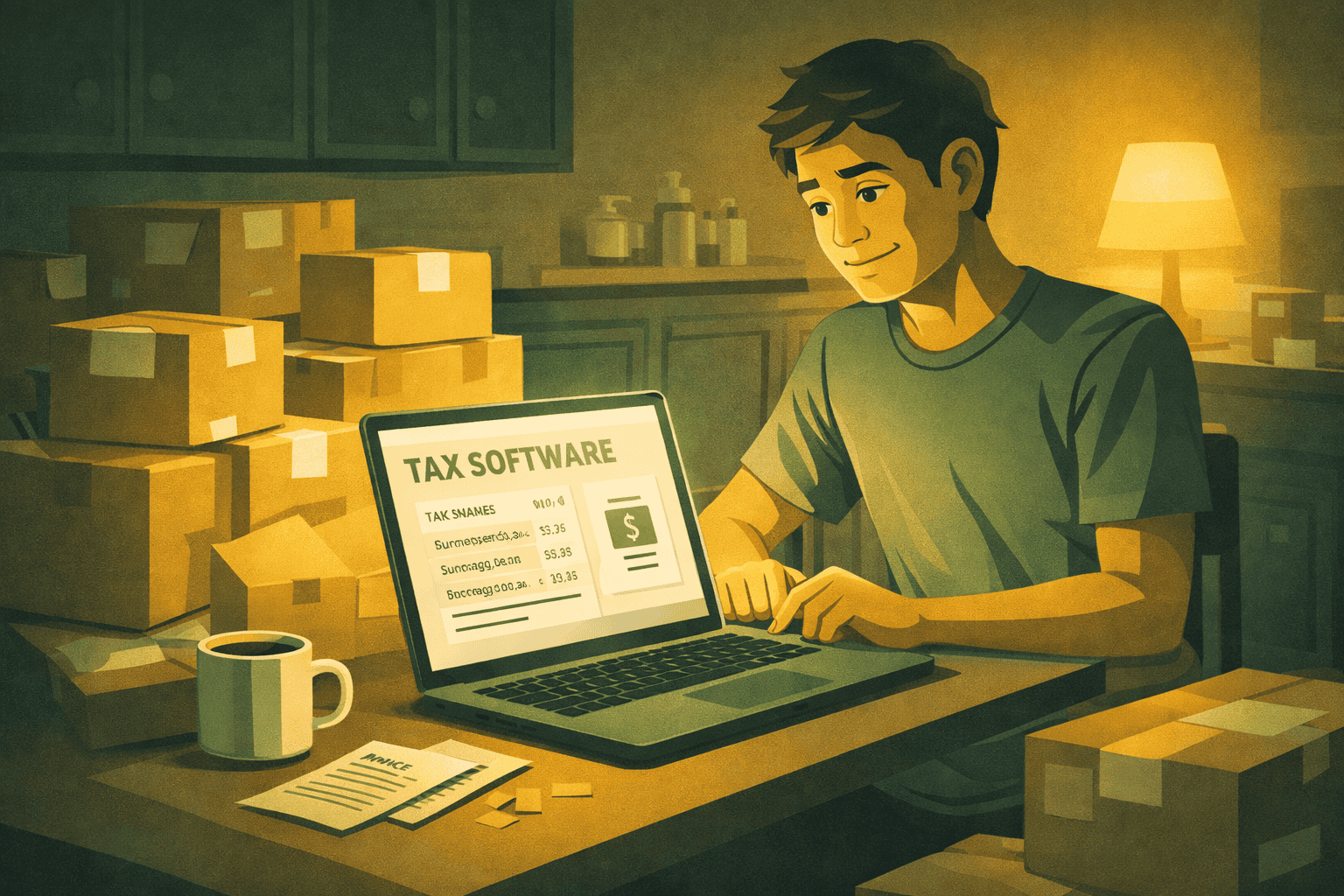
A warning for Amazon sellers, Shopify store owners, and online business owners
I was just talking to one of our clients, who shared this story with me:
“I started my first Amazon business in 2019. I wanted to save every dollar I could. So when tax time came, I bought tax software and did it myself.
For five years, I thought I was being smart. I thought I was saving money. My business was growing. The IRS accepted my tax returns.
I was wrong.
In year five, I got a scary letter. The IRS wanted to check my taxes. They found years of mistakes I didn’t know I was making. When it was all over, I had to pay $47,000. That’s back taxes, late fees, and the cost to fix everything.
Yes, forty-seven thousand dollars.”
Stories like this are why we created this guide. If you sell on Amazon, run a Shopify store, or have any online business, keep reading. These are the tax traps that catch e-commerce sellers every day. And this is why getting help from a pro is worth every penny.
Why E-Commerce Taxes Are So Hard
Regular stores have it easy. They buy stuff, sell it nearby, and pay taxes in one place. Online selling is way harder. You might owe taxes in many states at once.
The Many-States Problem
Before 2018, you only had to worry about sales tax where you had a store or office. Then a big court case changed everything. Now, 45 states can make you pay sales tax just because you sell a lot there. You don’t need to live there or even visit.
Each state has its own rules. Most states say you owe if you sell $100,000 or make 200 sales there. But some states are different. California and Texas set the bar at $500,000. New York wants both $500,000 in sales AND 100 orders.
If you use Amazon FBA, Amazon stores your stuff in warehouses all over the country. That means you might owe taxes in every state where your products sit. Our client was breaking the rules in 23 states and had no idea.
The IRS Is Watching Your Payments
Payment apps like PayPal and Stripe must tell the IRS how much money you get. They send a form called a 1099-K.
For 2025, the rule is: if you get more than $20,000 AND have more than 200 sales on one platform, you’ll get this form. But some states have stricter rules. In Vermont, Maryland, Virginia, and Massachusetts, the limit is just $600.
Here’s the big problem: The 1099-K shows all the money that came in. It doesn’t subtract fees or refunds. If PayPal says you got $175,000 but you only report $141,000, the IRS computer spots that right away. That’s what gets you audited.
The Five Mistakes That Costs $47,000
Looking back, our client made five big errors. Here’s what went wrong:
Mistake #1: Messing Up Product Costs
When you sell stuff, you can subtract what you paid for it. This is called “Cost of Goods Sold” or COGS. It sounds simple. It’s not.
COGS includes what you pay your supplier and shipping to get products to you. It does NOT include Amazon fees or PayPal fees. Those are separate.
Our client made two errors. First, he counted costs when he bought stuff, not when he sold it. If you buy $10,000 of products in December but sell them in January, that cost goes on next year’s taxes. Second, he mixed up Amazon storage fees with product costs. They’re not the same thing.
This made a big mess that took forever to fix.
Mistake #2: Not Tracking Inventory Right
The IRS wants to know how much stuff you have at the end of each year. You need to use the same method every time to figure this out.
He didn’t use any method. He just guessed. Bad idea. If you guess wrong and say you have more stuff than you do, you pay taxes on money you didn’t really make. That’s what happened to him.
Tip: Run your Amazon Inventory Report on January 1st every year. If you forget, fixing it later is really hard.
Mistake #3: Not Paying Taxes During the Year
Here’s a rule: If you’ll owe more than $1,000 in taxes, you must pay some every three months. The due dates are April 15, June 15, September 15, and January 15.
He knew this rule. But he didn’t follow it well. The IRS charges late fees even if you pay everything by April 15th. Those fees add up fast. His late fees alone were over $8,000.
Easy fix: Put 25-30% of every payment you get into a savings account just for taxes. Then pay it out four times a year like clockwork.
Mistake #4: Mixing Personal and Business Money
This mistake turns a simple audit into a nightmare. When you use the same card for groceries and business stuff, every expense looks fishy.
Our client used one credit card for everything. When the audit came, he spent three weeks going through every charge. He lost deductions he deserved because he couldn’t prove they were for business.
The IRS doesn’t care that you KNOW something was for business. You have to PROVE it.
Mistake #5: Taking Deductions in the Wrong Spots
Where you put a deduction on your taxes matters a lot. Some spots save you more money than others.
For example, if you pay property tax on a business building, you can list it as a personal deduction or a business expense. The business expense saves you more. I kept putting things in the wrong places and left thousands of dollars behind.
How the IRS Catches You
The IRS checks less than 1% of tax returns. That sounds good. But they’re smart about who they pick.
They use computers to compare numbers. If Stripe says you got $175,000 but you report $141,000, a computer flags that right away. If your deductions are way higher than other sellers like you, red flag. If you claim losses every year but live a nice life, red flag.
Tax software just asks you to fill in boxes. A good tax pro asks WHY your numbers look that way. They make sure your return won’t raise flags.

The Real Cost of Doing It Yourself
Let’s do the math he should have done years ago.
Tax software cost him about $150-250 each year. Over five years: about $1,000.
A tax pro who knows e-commerce costs about $800-2,500 each year. Over five years: about $4,000-12,500.
He “saved” maybe $3,000-11,000 by doing it himself.
But his mistakes cost him $47,000. Plus $6,200 in deductions he missed. Plus 200 hours of his time during the audit. Plus all the sales he lost while dealing with IRS letters.
Getting help would have paid for itself many times over.
What You Actually Need to Track
If you still want to do this yourself, here’s what you need:
Federal tax returns. State tax returns where you live. Sales tax filing in every state where you owe it (could be 45+ states!). Quarterly tax payments four times a year. Good records of what you paid for products. A way to match your 1099-K forms to what you report. Proof that every business expense was really for business.
For a typical Amazon seller, you might owe sales tax in dozens of states. Each state has different due dates. Miss one filing, even if you owe nothing, and you get hit with fees.
This is why sales tax software exists. Tools like TaxJar or Avalara track everything, calculate what you owe, and file for you. They cost $20-50 per month per state. That sounds like a lot, but it’s way cheaper than penalties.
How to Find a Good Tax Pro
Not all accountants know e-commerce. When you look for help, ask these questions:
How many Amazon or Shopify sellers do you work with? (Look for at least 5-10.) Can you explain what “economic nexus” means? How do you handle sales tax for FBA sellers? Do you help plan taxes all year, or just file once a year? How do you track product costs for resellers? What do you do when 1099-K numbers don’t match?
A good e-commerce tax pro should know these answers without looking them up. They should ask about your sales platforms, how you ship, and how your business is set up. When you tell them you’ve been doing your own taxes, they should look worried.

What Is Our Client Doing Now?
After his expensive lesson, here’s his setup:
He work with accountants who only help e-commerce businesses. They get Amazon fees, FBA storage, and selling in many states. We meet four times a year to plan, not just once to file.
He use software that connects to Amazon and sorts every sale for him. His books get updated every month, not once a year in a panic.
Sales tax is on autopilot. Software tracks where he owe, figures out the amounts, and files everything. He haven’t touched a sales tax form in two years.
Quarterly payments happen by themselves. Money moves from his business account to a tax savings account on the first of each month. Then it goes to the IRS on schedule.
Total cost each year: About $7,500 for the accountant, software, and tools.
Total savings from better deductions and no penalties: About $12,000-15,000.
Time spent worrying about taxes: Almost zero.
The Bottom Line
E-commerce taxes are truly hard. The IRS knows this. That’s why they tell small businesses to get help from pros.
Tax software is made for people with simple jobs and simple tax returns. Once you add inventory, sales in many states, and business deductions, you’ve outgrown it.
He learned this the hard way so you don’t have to. The $47,000 he lost could have been avoided with maybe $10,000 in help over five years. That’s like paying a 370% penalty for trying to save a few hundred dollars each year.
Your business deserves better than tax software and hope. Find an e-commerce tax expert. Set up good systems. Spend your time on what grows your business, selling products, not reading tax rules.
The best time to get tax help was when you started your business. The second best time is right now.
Ready to stop gambling with your e-commerce taxes? Tall Oak Advisors works only with online sellers, Amazon FBA businesses, Shopify stores, and e-commerce owners who’ve outgrown TurboTax. We speak your language: FBA fees, multi-state sales tax, inventory tracking, and 1099-K matching aren’t buzzwords to us. They’re what we do every day. Get a free quote and see what smart tax planning could save you this year at https://talloakadvisors.co/get-quote/ecommerce.

Take Control of Your Finances Today!
Whether you’re a Reseller (Wholesale, Retail Arbitrage, Online Arbitrage, Dropshipping) or a Brand Owner, managing finances is key to your success. We support eCommerce businesses across major platforms like Amazon, Shopify, eBay, Walmart, Etsy, BigCommerce, and beyond.
See if you qualify for a free strategy session with our team to learn how Tall Oak Advisors can streamline your bookkeeping and ensure accurate tax preparation for your business.
Need a quick quote?
Or explore our range of free resources crafted specifically for eCommerce sellers:
- Business Tax Worksheet
- Frequently Asked Questions About Taxes and Bookkeeping
- Tax Write-Offs Every Amazon and Shopify Seller Should Know
Take the first step toward a stronger financial future and position your business for long-term success.
A warning for Amazon sellers, Shopify store owners, and online business owners
I was just talking to one of our clients, who shared this story with me:
“I started my first Amazon business in 2019. I wanted to save every dollar I could. So when tax time came, I bought tax software and did it myself.
For five years, I thought I was being smart. I thought I was saving money. My business was growing. The IRS accepted my tax returns.
I was wrong.
In year five, I got a scary letter. The IRS wanted to check my taxes. They found years of mistakes I didn’t know I was making. When it was all over, I had to pay $47,000. That’s back taxes, late fees, and the cost to fix everything.
Yes, forty-seven thousand dollars.”
Stories like this are why we created this guide. If you sell on Amazon, run a Shopify store, or have any online business, keep reading. These are the tax traps that catch e-commerce sellers every day. And this is why getting help from a pro is worth every penny.
Why E-Commerce Taxes Are So Hard
Regular stores have it easy. They buy stuff, sell it nearby, and pay taxes in one place. Online selling is way harder. You might owe taxes in many states at once.
The Many-States Problem
Before 2018, you only had to worry about sales tax where you had a store or office. Then a big court case changed everything. Now, 45 states can make you pay sales tax just because you sell a lot there. You don’t need to live there or even visit.
Each state has its own rules. Most states say you owe if you sell $100,000 or make 200 sales there. But some states are different. California and Texas set the bar at $500,000. New York wants both $500,000 in sales AND 100 orders.
If you use Amazon FBA, Amazon stores your stuff in warehouses all over the country. That means you might owe taxes in every state where your products sit. Our client was breaking the rules in 23 states and had no idea.
The IRS Is Watching Your Payments
Payment apps like PayPal and Stripe must tell the IRS how much money you get. They send a form called a 1099-K.
For 2025, the rule is: if you get more than $20,000 AND have more than 200 sales on one platform, you’ll get this form. But some states have stricter rules. In Vermont, Maryland, Virginia, and Massachusetts, the limit is just $600.
Here’s the big problem: The 1099-K shows all the money that came in. It doesn’t subtract fees or refunds. If PayPal says you got $175,000 but you only report $141,000, the IRS computer spots that right away. That’s what gets you audited.
The Five Mistakes That Costs $47,000
Looking back, our client made five big errors. Here’s what went wrong:
Mistake #1: Messing Up Product Costs
When you sell stuff, you can subtract what you paid for it. This is called “Cost of Goods Sold” or COGS. It sounds simple. It’s not.
COGS includes what you pay your supplier and shipping to get products to you. It does NOT include Amazon fees or PayPal fees. Those are separate.
Our client made two errors. First, he counted costs when he bought stuff, not when he sold it. If you buy $10,000 of products in December but sell them in January, that cost goes on next year’s taxes. Second, he mixed up Amazon storage fees with product costs. They’re not the same thing.
This made a big mess that took forever to fix.
Mistake #2: Not Tracking Inventory Right
The IRS wants to know how much stuff you have at the end of each year. You need to use the same method every time to figure this out.
He didn’t use any method. He just guessed. Bad idea. If you guess wrong and say you have more stuff than you do, you pay taxes on money you didn’t really make. That’s what happened to him.
Tip: Run your Amazon Inventory Report on January 1st every year. If you forget, fixing it later is really hard.
Mistake #3: Not Paying Taxes During the Year
Here’s a rule: If you’ll owe more than $1,000 in taxes, you must pay some every three months. The due dates are April 15, June 15, September 15, and January 15.
He knew this rule. But he didn’t follow it well. The IRS charges late fees even if you pay everything by April 15th. Those fees add up fast. His late fees alone were over $8,000.
Easy fix: Put 25-30% of every payment you get into a savings account just for taxes. Then pay it out four times a year like clockwork.
Mistake #4: Mixing Personal and Business Money
This mistake turns a simple audit into a nightmare. When you use the same card for groceries and business stuff, every expense looks fishy.
Our client used one credit card for everything. When the audit came, he spent three weeks going through every charge. He lost deductions he deserved because he couldn’t prove they were for business.
The IRS doesn’t care that you KNOW something was for business. You have to PROVE it.
Mistake #5: Taking Deductions in the Wrong Spots
Where you put a deduction on your taxes matters a lot. Some spots save you more money than others.
For example, if you pay property tax on a business building, you can list it as a personal deduction or a business expense. The business expense saves you more. I kept putting things in the wrong places and left thousands of dollars behind.
How the IRS Catches You
The IRS checks less than 1% of tax returns. That sounds good. But they’re smart about who they pick.
They use computers to compare numbers. If Stripe says you got $175,000 but you report $141,000, a computer flags that right away. If your deductions are way higher than other sellers like you, red flag. If you claim losses every year but live a nice life, red flag.
Tax software just asks you to fill in boxes. A good tax pro asks WHY your numbers look that way. They make sure your return won’t raise flags.
The Real Cost of Doing It Yourself
Let’s do the math he should have done years ago.
Tax software cost him about $150-250 each year. Over five years: about $1,000.
A tax pro who knows e-commerce costs about $800-2,500 each year. Over five years: about $4,000-12,500.
He “saved” maybe $3,000-11,000 by doing it himself.
But his mistakes cost him $47,000. Plus $6,200 in deductions he missed. Plus 200 hours of his time during the audit. Plus all the sales he lost while dealing with IRS letters.
Getting help would have paid for itself many times over.
What You Actually Need to Track
If you still want to do this yourself, here’s what you need:
Federal tax returns. State tax returns where you live. Sales tax filing in every state where you owe it (could be 45+ states!). Quarterly tax payments four times a year. Good records of what you paid for products. A way to match your 1099-K forms to what you report. Proof that every business expense was really for business.
For a typical Amazon seller, you might owe sales tax in dozens of states. Each state has different due dates. Miss one filing, even if you owe nothing, and you get hit with fees.
This is why sales tax software exists. Tools like TaxJar or Avalara track everything, calculate what you owe, and file for you. They cost $20-50 per month per state. That sounds like a lot, but it’s way cheaper than penalties.
How to Find a Good Tax Pro
Not all accountants know e-commerce. When you look for help, ask these questions:
How many Amazon or Shopify sellers do you work with? (Look for at least 5-10.) Can you explain what “economic nexus” means? How do you handle sales tax for FBA sellers? Do you help plan taxes all year, or just file once a year? How do you track product costs for resellers? What do you do when 1099-K numbers don’t match?
A good e-commerce tax pro should know these answers without looking them up. They should ask about your sales platforms, how you ship, and how your business is set up. When you tell them you’ve been doing your own taxes, they should look worried.
What Is Our Client Doing Now?
After his expensive lesson, here’s his setup:
He work with accountants who only help e-commerce businesses. They get Amazon fees, FBA storage, and selling in many states. We meet four times a year to plan, not just once to file.
He use software that connects to Amazon and sorts every sale for him. His books get updated every month, not once a year in a panic.
Sales tax is on autopilot. Software tracks where he owe, figures out the amounts, and files everything. He haven’t touched a sales tax form in two years.
Quarterly payments happen by themselves. Money moves from his business account to a tax savings account on the first of each month. Then it goes to the IRS on schedule.
Total cost each year: About $7,500 for the accountant, software, and tools.
Total savings from better deductions and no penalties: About $12,000-15,000.
Time spent worrying about taxes: Almost zero.
The Bottom Line
E-commerce taxes are truly hard. The IRS knows this. That’s why they tell small businesses to get help from pros.
Tax software is made for people with simple jobs and simple tax returns. Once you add inventory, sales in many states, and business deductions, you’ve outgrown it.
He learned this the hard way so you don’t have to. The $47,000 he lost could have been avoided with maybe $10,000 in help over five years. That’s like paying a 370% penalty for trying to save a few hundred dollars each year.
Your business deserves better than tax software and hope. Find an e-commerce tax expert. Set up good systems. Spend your time on what grows your business, selling products, not reading tax rules.
The best time to get tax help was when you started your business. The second best time is right now.
Ready to stop gambling with your e-commerce taxes? Tall Oak Advisors works only with online sellers, Amazon FBA businesses, Shopify stores, and e-commerce owners who’ve outgrown TurboTax. We speak your language: FBA fees, multi-state sales tax, inventory tracking, and 1099-K matching aren’t buzzwords to us. They’re what we do every day. Get a free quote and see what smart tax planning could save you this year at https://talloakadvisors.co/get-quote/ecommerce.
Take Control of Your Finances Today!
Whether you’re a Reseller (Wholesale, Retail Arbitrage, Online Arbitrage, Dropshipping) or a Brand Owner, managing finances is key to your success. We support eCommerce businesses across major platforms like Amazon, Shopify, eBay, Walmart, Etsy, BigCommerce, and beyond.
See if you qualify for a free strategy session with our team to learn how Tall Oak Advisors can streamline your bookkeeping and ensure accurate tax preparation for your business.
Need a quick quote?
Or explore our range of free resources crafted specifically for eCommerce sellers:
- 7 Profit Crushing Mistakes That Will Destroy Your eCommerce Business
- Business Tax Worksheet
- Frequently Asked Questions About Taxes and Bookkeeping
- Tax Write-Offs Every Amazon and Shopify Seller Should Know
Take the first step toward a stronger financial future and position your business for long-term success.