
A Simple Tax Checklist for Amazon, Shopify, and Online Sellers
Tax time doesn’t have to be hard. You just need the right papers ready.
If you sell on Amazon, Shopify, or any online store, your accountant needs certain documents. These papers help you pay less in taxes. They also keep you out of trouble with the IRS.
Missing papers can cost you a lot. Some sellers pay $10,000 to $50,000 extra when they don’t have good records.
This guide shows you what to get. It also tells you where to find each document.
1. Form 1099-K: Your Sales Report
What is it? This form shows how much money came through your selling accounts. Amazon, eBay, Etsy, and PayPal all send this form.
Important change: In 2024, you get this form if you made $5,000 or more. In 2025 and after, the limit went back up to $20,000 and 200 sales.
Key point: This form shows your total sales. It is NOT your profit. It includes shipping, refunds, and taxes that Amazon collected. Your real income is much lower.
Where to find it:
- Amazon: Seller Central → Reports → Tax Document Library
- Shopify: Settings → Payments → Tax Documents
- eBay: My eBay → Account → Payments Tab
- PayPal: Activity → Statements → Tax Documents
Tip: Always check this form against your own records. Mistakes happen. You are responsible for fixing them.
2. Sales Tax Reports
Good news! Amazon, eBay, and Etsy now collect sales tax for you in most states. But you still need records of what they collected.
What you need:
- Reports showing taxes Amazon collected for you
- Sales reports by state
- Records of any taxes YOU collected on your own website
Where to find it: Amazon Seller Central → Reports → Tax Document Library
Watch out: If you sell on your own website too, you must collect sales tax yourself. Amazon only handles Amazon sales.
3. Transaction Reports
These reports show every sale you made. They break down each order, refund, and fee.
What to download:
- Amazon: Date Range Reports from Seller Central → Reports → Payments
- Shopify: Analytics → Reports → Sales
- eBay: Seller Hub → Performance → Sales
Why it matters: These reports help your accountant find all the fees you paid. Amazon takes 8% to 45% in fees. Those fees lower your taxes!
4. Cost of Goods Sold (COGS) Papers
COGS means what you paid to get your products. This is a big tax saver. The IRS lets you subtract these costs from your income.
Keep these papers:
- Bills from your suppliers
- Shipping costs to get products to you or Amazon
- Import fees if you buy from other countries
- Counts of your stock at the start and end of the year
Simple math: Stock you started with + What you bought – Stock you ended with = Your costs
IRS rule: Pick one way to count your stock and stick with it every year.
5. Bank Statements
Your bank records prove that the money you report matches what you got.
Give your accountant:
- 12 months of business bank statements
- Business credit card statements
- PayPal or Stripe yearly reports
Big mistake to avoid: Don’t mix business and personal money. The IRS says this is a problem. Keep them in different accounts.
6. Platform Fee Statements
You can subtract all the fees that Amazon, Shopify, and other sites charge you.
Get fee records from:
- Amazon: Transaction reports and FBA fee reports
- Shopify: Monthly bills and app costs
- eBay: Selling fees and promoted listing fees
- PayPal/Stripe: Payment fees (usually about 3% per sale)
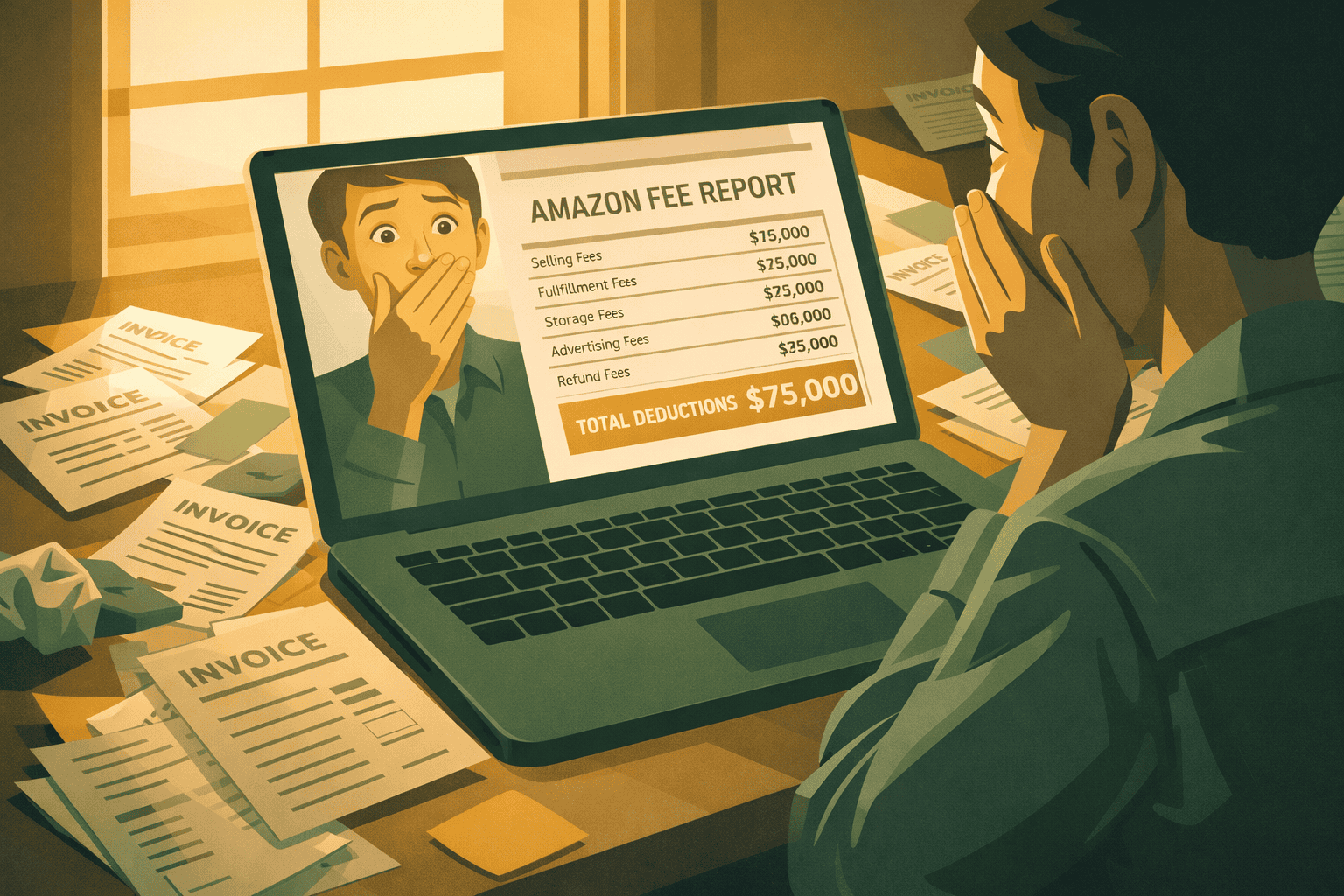
Example: If you sold $500,000 on Amazon, you may have paid $75,000 to $150,000 in fees. That’s a huge tax saver!
7. Inventory Location Report (For Amazon FBA)
If you use Amazon FBA, this report is very important. It shows where Amazon keeps your products.
Where to find it: Seller Central → Reports → Fulfillment → Inventory Event Detail
Why it matters:
- Tax filing: Some states want you to file taxes if Amazon stores your stuff there.
- Lost items: Shows products that got lost or broken. You can deduct these losses.
Good habit: Count your stock yourself every few months. This helps catch mistakes.
8. Business Expense Receipts
You can deduct many costs from your taxes. But you need proof for each one.
Common costs you can deduct:
- Ads: Amazon ads, Facebook ads, Google ads
- Software: Tools you pay for monthly
- Help: Accountants, lawyers, coaches
- Supplies: Boxes, tape, labels, printer ink
- Home office: Part of your rent and electric bill
- Car: Trips to the post office or to meet suppliers (67 cents per mile in 2024)
- Learning: Courses and classes for your business
Tip: Take photos of receipts with your phone. Digital copies are fine with the IRS.
9. Contractor Payment Records
If you paid helpers $600 or more, you need records. You may also need to send them a tax form.
Keep records for:
- Virtual helpers
- Photo and design people
- Bookkeepers
- Anyone who does work for your business
Important: Get a W-9 form from helpers BEFORE you pay them. Don’t wait until the end of the year.
10. Business Setup Papers
Your accountant needs to know how your business is set up to file taxes correctly.
Give copies of:
- Your EIN letter from the IRS
- LLC or company papers
- S-Corp election letter (if you have one)
- Business licenses
- Sales tax permits
11. Quarterly Tax Payment Records
If you think you’ll owe $1,000 or more in taxes, you should pay the IRS four times a year. Keep proof of these payments.
Save records of:
- Federal payments
- State payments
- Payment dates and amounts
Due dates: April 15, June 15, September 15, and January 15
12. Resale Certificates
When you buy products to resell, you shouldn’t pay sales tax on them. A resale certificate proves this.
Keep copies of:
- Resale certificates you gave to suppliers
- Certificates from anyone who buys from you to resell
Warning: If you get audited without these certificates, you pay the tax. You can’t go back and collect it from your customers.
7 Big Tax Mistakes to Avoid
- Thinking your 1099-K is your profit. It’s not. Your real income is much lower after fees and costs.
- Forgetting about other states. If Amazon stores your stuff in a state, you may need to file taxes there.
- Missing lost product deductions. Lost or broken stock lowers your taxes.
- Not tracking use tax. If you give away free samples, you might owe extra tax.
- Mixing personal and business accounts. This is a red flag for the IRS.
- Not keeping receipts. No proof means no deduction.
- Skipping zero returns. Some states want tax filings even when Amazon paid all the tax.
How Long to Keep Your Papers
The IRS has rules about how long to save your records:
- 3 years: Most tax records
- 4 years: Employee records
- 6 years: If you forgot to report a lot of income
- 7 years: Bad debt write-offs
- Forever: If you didn’t file a return
For equipment and cars: Keep papers until you sell them, plus 3 more years.
Your Simple Action Plan
January:
- Download your 1099-K forms
- Count your stock
- Download all reports from last year
February:
- Check your 1099-K against your records
- Sort your receipts by type
- Send 1099 forms to your contractors
March:
- Give all papers to your accountant
- Review your tax return before filing
- Set up your first quarterly payment

The Bottom Line
The IRS now uses computers to check if your numbers match up. If they find problems, they flag your account.
But here’s the good news: Good records help you pay less tax. Platform fees, product costs, supplies, and home office costs all lower what you owe. Sellers with clean records don’t just avoid trouble. They save money.
Start getting these 12 documents ready now. Your future self will thank you.
Ready to Stop Stressing About Tax Documents?
Getting these 12 documents is just the first step. You also need an accountant who knows e-commerce.
At Tall Oak Advisors, we only work with e-commerce businesses like yours. We know Amazon FBA. We know Shopify. We know all the fees and reports.
No explaining what FBA fees are. No blank stares when you talk about COGS. Just help from a team that speaks your language.
Get your free quote today at https://talloakadvisors.co/get-quote/ecommerce and head into tax season with confidence.

Take Control of Your Finances Today!
Whether you’re a Reseller (Wholesale, Retail Arbitrage, Online Arbitrage, Dropshipping) or a Brand Owner, managing finances is key to your success. We support eCommerce businesses across major platforms like Amazon, Shopify, eBay, Walmart, Etsy, BigCommerce, and beyond.
See if you qualify for a free strategy session with our team to learn how Tall Oak Advisors can streamline your bookkeeping and ensure accurate tax preparation for your business.
Need a quick quote?
Or explore our range of free resources crafted specifically for eCommerce sellers:
- Business Tax Worksheet
- Frequently Asked Questions About Taxes and Bookkeeping
- Tax Write-Offs Every Amazon and Shopify Seller Should Know
Take the first step toward a stronger financial future and position your business for long-term success.
A Simple Tax Checklist for Amazon, Shopify, and Online Sellers
Tax time doesn’t have to be hard. You just need the right papers ready.
If you sell on Amazon, Shopify, or any online store, your accountant needs certain documents. These papers help you pay less in taxes. They also keep you out of trouble with the IRS.
Missing papers can cost you a lot. Some sellers pay $10,000 to $50,000 extra when they don’t have good records.
This guide shows you what to get. It also tells you where to find each document.
1. Form 1099-K: Your Sales Report
What is it? This form shows how much money came through your selling accounts. Amazon, eBay, Etsy, and PayPal all send this form.
Important change: In 2024, you get this form if you made $5,000 or more. In 2025 and after, the limit went back up to $20,000 and 200 sales.
Key point: This form shows your total sales. It is NOT your profit. It includes shipping, refunds, and taxes that Amazon collected. Your real income is much lower.
Where to find it:
- Amazon: Seller Central → Reports → Tax Document Library
- Shopify: Settings → Payments → Tax Documents
- eBay: My eBay → Account → Payments Tab
- PayPal: Activity → Statements → Tax Documents
Tip: Always check this form against your own records. Mistakes happen. You are responsible for fixing them.
2. Sales Tax Reports
Good news! Amazon, eBay, and Etsy now collect sales tax for you in most states. But you still need records of what they collected.
What you need:
- Reports showing taxes Amazon collected for you
- Sales reports by state
- Records of any taxes YOU collected on your own website
Where to find it: Amazon Seller Central → Reports → Tax Document Library
Watch out: If you sell on your own website too, you must collect sales tax yourself. Amazon only handles Amazon sales.
3. Transaction Reports
These reports show every sale you made. They break down each order, refund, and fee.
What to download:
- Amazon: Date Range Reports from Seller Central → Reports → Payments
- Shopify: Analytics → Reports → Sales
- eBay: Seller Hub → Performance → Sales
Why it matters: These reports help your accountant find all the fees you paid. Amazon takes 8% to 45% in fees. Those fees lower your taxes!
4. Cost of Goods Sold (COGS) Papers
COGS means what you paid to get your products. This is a big tax saver. The IRS lets you subtract these costs from your income.
Keep these papers:
- Bills from your suppliers
- Shipping costs to get products to you or Amazon
- Import fees if you buy from other countries
- Counts of your stock at the start and end of the year
Simple math: Stock you started with + What you bought – Stock you ended with = Your costs
IRS rule: Pick one way to count your stock and stick with it every year.
5. Bank Statements
Your bank records prove that the money you report matches what you got.
Give your accountant:
- 12 months of business bank statements
- Business credit card statements
- PayPal or Stripe yearly reports
Big mistake to avoid: Don’t mix business and personal money. The IRS says this is a problem. Keep them in different accounts.
6. Platform Fee Statements
You can subtract all the fees that Amazon, Shopify, and other sites charge you.
Get fee records from:
- Amazon: Transaction reports and FBA fee reports
- Shopify: Monthly bills and app costs
- eBay: Selling fees and promoted listing fees
- PayPal/Stripe: Payment fees (usually about 3% per sale)
Example: If you sold $500,000 on Amazon, you may have paid $75,000 to $150,000 in fees. That’s a huge tax saver!
7. Inventory Location Report (For Amazon FBA)
If you use Amazon FBA, this report is very important. It shows where Amazon keeps your products.
Where to find it: Seller Central → Reports → Fulfillment → Inventory Event Detail
Why it matters:
- Tax filing: Some states want you to file taxes if Amazon stores your stuff there.
- Lost items: Shows products that got lost or broken. You can deduct these losses.
Good habit: Count your stock yourself every few months. This helps catch mistakes.
8. Business Expense Receipts
You can deduct many costs from your taxes. But you need proof for each one.
Common costs you can deduct:
- Ads: Amazon ads, Facebook ads, Google ads
- Software: Tools you pay for monthly
- Help: Accountants, lawyers, coaches
- Supplies: Boxes, tape, labels, printer ink
- Home office: Part of your rent and electric bill
- Car: Trips to the post office or to meet suppliers (67 cents per mile in 2024)
- Learning: Courses and classes for your business
Tip: Take photos of receipts with your phone. Digital copies are fine with the IRS.
9. Contractor Payment Records
If you paid helpers $600 or more, you need records. You may also need to send them a tax form.
Keep records for:
- Virtual helpers
- Photo and design people
- Bookkeepers
- Anyone who does work for your business
Important: Get a W-9 form from helpers BEFORE you pay them. Don’t wait until the end of the year.
10. Business Setup Papers
Your accountant needs to know how your business is set up to file taxes correctly.
Give copies of:
- Your EIN letter from the IRS
- LLC or company papers
- S-Corp election letter (if you have one)
- Business licenses
- Sales tax permits
11. Quarterly Tax Payment Records
If you think you’ll owe $1,000 or more in taxes, you should pay the IRS four times a year. Keep proof of these payments.
Save records of:
- Federal payments
- State payments
- Payment dates and amounts
Due dates: April 15, June 15, September 15, and January 15
12. Resale Certificates
When you buy products to resell, you shouldn’t pay sales tax on them. A resale certificate proves this.
Keep copies of:
- Resale certificates you gave to suppliers
- Certificates from anyone who buys from you to resell
Warning: If you get audited without these certificates, you pay the tax. You can’t go back and collect it from your customers.
7 Big Tax Mistakes to Avoid
- Thinking your 1099-K is your profit. It’s not. Your real income is much lower after fees and costs.
- Forgetting about other states. If Amazon stores your stuff in a state, you may need to file taxes there.
- Missing lost product deductions. Lost or broken stock lowers your taxes.
- Not tracking use tax. If you give away free samples, you might owe extra tax.
- Mixing personal and business accounts. This is a red flag for the IRS.
- Not keeping receipts. No proof means no deduction.
- Skipping zero returns. Some states want tax filings even when Amazon paid all the tax.
How Long to Keep Your Papers
The IRS has rules about how long to save your records:
- 3 years: Most tax records
- 4 years: Employee records
- 6 years: If you forgot to report a lot of income
- 7 years: Bad debt write-offs
- Forever: If you didn’t file a return
For equipment and cars: Keep papers until you sell them, plus 3 more years.
Your Simple Action Plan
January:
- Download your 1099-K forms
- Count your stock
- Download all reports from last year
February:
- Check your 1099-K against your records
- Sort your receipts by type
- Send 1099 forms to your contractors
March:
- Give all papers to your accountant
- Review your tax return before filing
- Set up your first quarterly payment
The Bottom Line
The IRS now uses computers to check if your numbers match up. If they find problems, they flag your account.
But here’s the good news: Good records help you pay less tax. Platform fees, product costs, supplies, and home office costs all lower what you owe. Sellers with clean records don’t just avoid trouble. They save money.
Start getting these 12 documents ready now. Your future self will thank you.
Ready to Stop Stressing About Tax Documents?
Getting these 12 documents is just the first step. You also need an accountant who knows e-commerce.
At Tall Oak Advisors, we only work with e-commerce businesses like yours. We know Amazon FBA. We know Shopify. We know all the fees and reports.
No explaining what FBA fees are. No blank stares when you talk about COGS. Just help from a team that speaks your language.
Get your free quote today at https://talloakadvisors.co/get-quote/ecommerce and head into tax season with confidence.
Take Control of Your Finances Today!
Whether you’re a Reseller (Wholesale, Retail Arbitrage, Online Arbitrage, Dropshipping) or a Brand Owner, managing finances is key to your success. We support eCommerce businesses across major platforms like Amazon, Shopify, eBay, Walmart, Etsy, BigCommerce, and beyond.
See if you qualify for a free strategy session with our team to learn how Tall Oak Advisors can streamline your bookkeeping and ensure accurate tax preparation for your business.
Need a quick quote?
Or explore our range of free resources crafted specifically for eCommerce sellers:
- 7 Profit Crushing Mistakes That Will Destroy Your eCommerce Business
- Business Tax Worksheet
- Frequently Asked Questions About Taxes and Bookkeeping
- Tax Write-Offs Every Amazon and Shopify Seller Should Know
Take the first step toward a stronger financial future and position your business for long-term success.